Early symptoms of COPD you should know: Clinical signs and diagnosis explained
Early symptoms of COPD you should know can be subtle: a cough blamed on a lingering cold, getting winded while climbing stairs, or quietly reducing everyday activities because they feel more difficult. Harvard Health describes this gradual pattern as a reason COPD is often normalized as aging, deconditioning, weather sensitivity, or repeated illness, particularly when symptoms change over time and a risk factor is present. 1
What COPD is and why early signs matter
Chronic obstructive pulmonary disease is a long-term condition involving persistent narrowing or obstruction of the airways. It includes chronic obstructive bronchitis, emphysema, or both. The disease reduces airflow, especially when breathing out, and can progressively make ordinary breathing more difficult. Merck Manual reports that cigarette smoking is the most important cause, while exposure to toxins from biomass fuels such as wood and grasses also contributes worldwide. 2
COPD is common but frequently underdiagnosed. Merck Manual estimates that about 16 million people in the United States have the condition, while Harvard Health reports that at least 11 million Americans are affected. These figures differ because sources use different definitions and reporting methods, but both indicate a substantial public-health burden. Early symptoms do not establish COPD by themselves, yet recognizing a persistent pattern can help distinguish a breathing problem from a temporary respiratory infection. 1 2
Persistent cough and mucus production
A chronic cough, with or without phlegm, is one of the most recognizable early symptoms. It may be mild, occur mainly in the morning, or be described as a smoker's cough, which can make it easy to dismiss. Increased mucus and frequent throat clearing may accompany it. Chronic bronchitis has a formal definition of cough producing sputum for at least three months across two consecutive years, although a person does not need to meet that definition to warrant evaluation. 2 7
The important feature is persistence or change rather than a single episode of coughing. A cough that remains after a cold, becomes more frequent, produces more mucus, or occurs alongside breathlessness deserves clinical attention, especially in someone with a history of smoking or inhaled irritant exposure. The National Heart, Lung, and Blood Institute identifies ongoing cough and mucus production among common COPD symptoms, while the CDC also lists cough and mucus as symptoms that may occur with the disease. 8 9
Breathlessness, wheezing, and chest tightness
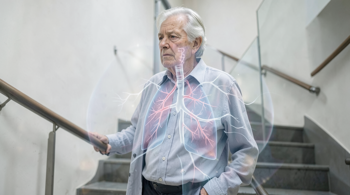
Shortness of breath during physical activity is another central warning sign. It may first appear during faster walking, climbing stairs, exercising, or carrying items that were previously manageable. Harvard pulmonary specialist Jessica McCannon notes that new or changing breathlessness with exertion may indicate COPD when an associated risk factor exists. The symptom often develops slowly, so people may compensate by walking more slowly, pausing, or avoiding demanding activities rather than recognizing a decline in lung function. 1
Wheezing is a whistling sound during breathing, while chest tightness can feel like pressure or restricted expansion. These symptoms are not specific to COPD and can also occur with asthma, infections, or other conditions, so they should not be used to self-diagnose. Professional references describe productive cough, dyspnea, wheezing, and chest tightness as common respiratory manifestations. A pattern that is recurrent, persistent, or progressively limiting is more significant than an isolated symptom. 5 6 9
Reduced stamina and recurring chest infections
Reduced exercise tolerance can be an early functional clue. A person may need longer to recover after routine activity, stop more often during a familiar walk, or feel unusually tired while completing ordinary tasks. Fatigue and low energy are recognized COPD symptoms, although they can have many other causes. The change from a person's usual level of activity is clinically more informative than a comparison with another person's fitness. 3 10
Some people with COPD experience recurring bronchitis, pneumonia, or other chest infections, or find that respiratory illnesses linger longer than expected. Repeated infections can also worsen existing airflow limitation and contribute to episodes of increased coughing, mucus, and breathlessness. EUFOREA lists recurring chest infections among typical symptoms, while Mayo Clinic includes frequent respiratory infections among possible COPD-related symptoms. These patterns require medical assessment because infections and COPD can influence each other. 7 11
Risk factors beyond cigarette smoking
Smoking is the leading COPD risk factor, but it is not the only one. Long-term exposure to secondhand smoke, workplace dust or fumes, air pollution, and indoor smoke from cooking or heating fuels can injure the airways. Genetic factors can also contribute. Franciscan Health reports that approximately one in six people with COPD never smoked, while HealthCentral cites the American Lung Association's estimate that one in four people with COPD have never smoked. Differences may reflect varying populations and definitions. 4 8
Risk is particularly relevant when symptoms occur in someone older than 40, a current or former smoker, or a person with occupational exposure to dust, chemicals, or fumes. Childhood airway problems, frequent respiratory infections, and alpha-1 antitrypsin deficiency are also identified as possible contributors. The presence of a risk factor does not prove COPD, and its absence does not exclude it. Symptom history, exposure history, examination, and objective testing must be considered together. 4 5 7
How COPD is confirmed and when symptoms need attention
Symptoms alone cannot confirm COPD because cough and breathlessness overlap with asthma, infections, cardiovascular conditions, and other lung disorders. Diagnosis generally combines medical history, physical examination, chest imaging when appropriate, and pulmonary function testing. Spirometry is especially important because it measures airflow and is required to establish COPD in people with persistent respiratory symptoms or relevant risk factors. 2 3 13
A gradual increase in cough, mucus, wheezing, or exertional breathlessness should be discussed with a healthcare professional, particularly when daily activities are being reduced. A sudden worsening may represent an exacerbation, which can involve more coughing, increased or discolored phlegm, and substantially worse breathlessness. Blue lips, confusion, or breathing that suddenly becomes much more difficult are warning signs requiring urgent medical attention. 6 7
Sources
- Harvard Health, “COPD symptoms: How to spot them early”
- Merck Manual Consumer Version, “Chronic Obstructive Pulmonary Disease (COPD)”
- NCBI Bookshelf, StatPearls, “Chronic Obstructive Pulmonary Disease (COPD)”
- Franciscan Health, “COPD Causes & Symptoms”
- MSD Manual Professional Edition, “Chronic Obstructive Pulmonary Disease (COPD)”
- Acibadem Hospitals Group, “COPD Symptoms: Possible Causes and When To Seek Care”
- EUFOREA, “Symptoms of COPD”
- Centers for Disease Control and Prevention, “About COPD”
- National Heart, Lung, and Blood Institute, “COPD Symptoms”
- American Lung Association, “COPD Symptoms and Diagnosis”
- Mayo Clinic, “COPD: Symptoms and causes”
- American Academy of Family Physicians, “Chronic Obstructive Pulmonary Disease: Diagnosis and Management”
Authored by 24Trendz team