Train journeys across the New England coast: A comparative guide to scenic rail corridors
The 145-mile train route connecting Boston with Brunswick is one of the most discussed rail journeys across the New England coast, linking small towns, fresh seafood destinations, historic centers, and coastal views. The Amtrak Downeaster provides the clearest northbound example, while commuter, regional, seasonal, and heritage railways create additional ways to experience the shoreline without making the entire trip by car.1
The Downeaster from Boston to Brunswick
The Amtrak Downeaster runs between Boston’s North Station and Brunswick, Maine, across approximately 145 miles and three states: Massachusetts, New Hampshire, and Maine. The journey takes roughly 3.5 hours, and the service operates multiple times daily. Key coastal or near-coastal destinations along the corridor include Saco, Portland, and Brunswick, each offering different combinations of beaches, seafood, history, and walkable downtown areas.1
The train is structured more like a regional service than a long-distance journey. Passenger amenities identified in the available route information include Wi-Fi, café service, bicycle accommodations, and pet-friendly travel for small dogs and cats. Business Class provides additional legroom, leather seating, and a nonalcoholic beverage, but the choice of accommodation changes the travel experience and may affect the total fare.1
North Shore commuter rail options
Massachusetts’ Newburyport/Rockport commuter rail line provides access to two distinct North Shore branches from Boston’s North Station. The line splits at Beverly, allowing travel toward either Newburyport or Rockport. The corridor is associated with salt marshes, rocky shoreline, art galleries, seafood restaurants, and seaside communities, making it suited to short outings as well as longer coastal itineraries.2
Newburyport Station is not directly in the center of downtown Newburyport. The supplied travel information places the downtown area about 1.4 miles away and identifies rideshare as one possible connection. That distinction matters because a rail journey can still require a final local transfer. Travelers should also allow time for walking between the station and waterfront areas, especially when carrying beach equipment or traveling during busy summer periods.2
South Shore and Boston-area connections
The MBTA commuter rail network extends beyond the North Shore, serving coastal communities including Hingham and other points around the Boston region. The broader system also provides routes toward Newburyport and Rockport, giving travelers several possible starting points for shoreline excursions. These services function primarily as regional transportation rather than dedicated sightseeing trains, so views and station surroundings vary by line and time of day.5
Boston transfers can be an important source of friction. A traveler arriving at South Station on an Amtrak Northeast Regional service may need to cross the city to North Station before boarding the Downeaster. One examined Providence-to-Portland itinerary described this as a Providence to Boston South Station, Boston South Station to Boston North Station, and Portland routing, with the local transfer adding time, complexity, and transportation cost outside the intercity rail ticket.10
Cape Cod by seasonal and excursion train
The CapeFLYER provides seasonal weekend passenger rail service between Boston and Hyannis on Cape Cod. Because it is seasonal and weekend-oriented, it differs from the daily commuter and intercity corridors farther north. Its usefulness depends on the operating calendar, the intended Cape destination, and whether the final stop is within walking distance of the traveler’s plans.4
The Cape Cod Central Railroad serves a different purpose. It operates scenic excursion trains through the Cape Cod Canal area and the peninsula’s woodlands, including dinner-train experiences described in the supplied material. These trains are tourism-focused rather than a general substitute for scheduled transportation, and their route, operating days, meal arrangements, and departure times should be treated as itinerary-specific details rather than assumed year-round conditions.8
Connecticut’s shoreline rail corridor
The Northeast Regional serves the southern New England coast, with stops including Providence, Rhode Island, and New London, Connecticut. The Connecticut segment is closely associated with Long Island Sound, placing passengers near one of the region’s major coastal waters. It also creates a longer-distance rail connection between Massachusetts, Rhode Island, and Connecticut, although station access to individual beaches and harbors varies.3
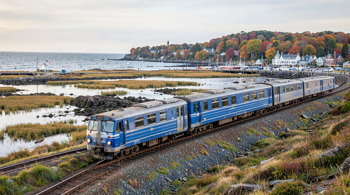
Shore Line East provides daily commuter service along the Connecticut coastline between New Haven and New London. This corridor is distinct from the Downeaster because it operates within Connecticut and is designed for regional movement along the Sound. Essex Steam Train and Riverboat offers another Connecticut experience, combining heritage rail travel in the Connecticut River Valley with a connection to coastal waterways rather than functioning as a conventional intercity service.67
Seasonality, scenery, and travel conditions
Summer is associated with peak beach use and waterfront dining along the northern coastal corridor, while fall brings foliage and changing rail views across New England. The Downeaster’s route passes through landscapes that include New Hampshire salt marshes and Maine’s rocky inlets. Scenic quality is therefore seasonal and weather-dependent, and a journey marketed around shoreline views may also include inland stretches and developed urban areas.12
Autumn rail itineraries can combine several different forms of travel. A published New England itinerary includes the Downeaster, the Conway Scenic Railroad through New Hampshire’s White Mountains, and the Cape Cod Central Railroad dinner train. It also combines rail with a Lake Winnipesaukee cruise and road travel, illustrating that many “coastal” rail vacations are multimodal rather than continuous train journeys from one shoreline town to another.9
Planning limits and practical comparisons
The main planning issue is that New England’s coastal rail services do not form one uninterrupted passenger railway. The Downeaster, Northeast Regional, MBTA lines, Shore Line East, CapeFLYER, and heritage railways have different operators, stations, schedules, and purposes. A route may therefore require a city transfer, a rideshare, a local bus, or a walk from the station before reaching a beach, harbor, historic district, or lighthouse area.210
| Rail service | General corridor | Primary role |
|---|---|---|
| Downeaster | Boston to Brunswick | Intercity travel across Massachusetts, New Hampshire, and Maine |
| Newburyport/Rockport Line | Boston to the North Shore | Commuter access to coastal communities |
| CapeFLYER | Boston to Hyannis | Seasonal weekend Cape Cod service |
| Shore Line East | New Haven to New London | Daily Connecticut coastal commuter service |
| Heritage railways | Connecticut River Valley and Cape Cod | Scenic or excursion-focused travel |
Fares and schedules can change according to travel date, service type, holiday demand, accommodation, and advance booking. A reported Providence-to-Portland fare near $205 was described as a possible coach quote for a specific search, not a stable price for every Rhode Island-to-Maine trip. That example also excludes the practical implications of the Boston transfer, local transit, food, delays, and any overnight accommodation.10
What the coastal rail network reveals
Train journeys across the New England coast are best understood as a collection of connected corridors rather than a single panoramic railway. The Downeaster supplies the strongest Boston-to-Maine spine, Massachusetts commuter rail reaches North Shore and South Shore communities, and Connecticut services follow the Long Island Sound region. Seasonal and heritage trains add scenic or dining experiences that are not equivalent to daily transportation.156
The network’s advantages include reduced dependence on driving, access to historic downtowns, and the ability to observe marshes, inlets, forests, and shoreline landscapes from a passenger seat. Its limitations include seasonal operation, station-to-destination gaps, separate ticketing or operators, and transfer exposure. Checking the relevant official schedule and the exact station pair remains essential because service patterns and conditions are not interchangeable across New England’s rail systems.34
Sources
- AOL, “This 145-mile Train Route Is One of the Most Beautiful in New England”
- Mass By Train, “All Aboard! Coastal New England Adventures by Commuter Rail”
- Amtrak Downeaster
- CapeFLYER
- MBTA
- Shore Line East
- Essex Steam Train & Riverboat
- Cape Cod Central Railroad
- Great Rail Journeys, “Fall Foliage of New England & Maine”
- Cultural Creatives, “The $205 Overhyped Train Trip From Rhode Island to Maine”
Authored by 24Trendz team