Which states offer the highest nursing salaries? A data-based analysis
Which states offer the highest nursing salaries? Available 2026 salary comparisons consistently place California at the top, followed by states such as Hawaii, Oregon, Washington, Massachusetts, Alaska, and New York. The figures below describe reported salary averages or medians, not guaranteed wages for individual positions, and differences in methodology make direct comparisons imperfect.
Location affects nursing compensation through hospital funding, staffing shortages, union representation, labor regulations, specialty demand, and regional living costs. A high annual salary can therefore indicate strong nominal earnings without necessarily representing the greatest purchasing power for a particular nurse.
States with the highest reported RN pay
California is the clearest leader in the available data. One 2026 comparison places California median RN pay above $150,000, while another estimates average California salaries at approximately $137,000 to $145,000. Hawaii, Oregon, Washington, Alaska, Massachusetts, and New York also appear repeatedly near the top, although their reported amounts vary according to whether the source measures mean or median wages. 1 2 3
| State | Reported annual RN salary | Position in reported rankings |
|---|---|---|
| California | $137,000 to more than $150,000 | Highest |
| Hawaii | $104,000 to more than $125,000 | Among the highest |
| Oregon | $93,000 to more than $122,000 | Among the highest |
| Washington | $92,500 to more than $117,000 | Among the highest |
| Massachusetts | $96,500 to more than $113,000 | Among the highest |
| Alaska | More than $115,000 in one median-based ranking | Among the highest |
| New York | $90,000 to more than $112,000 | Among the highest |
How the salary rankings should be interpreted
Reported rankings are not interchangeable because they use different measures. A mean wage can be pulled upward by senior nurses, highly paid metropolitan areas, overtime, and specialty roles, while a median identifies the midpoint of the workforce. The data also combines estimates described as current 2026 figures with Bureau of Labor Statistics data from earlier periods or adjustments for wage growth. Consequently, the rankings are most useful for identifying broad patterns rather than predicting an exact offer. 1 2 3
| Comparison type | What it indicates | Important limitation |
|---|---|---|
| Annual mean wage | Average earnings across a state or workforce | Can be influenced by seniority and high-paying metros |
| Median salary | Middle point in the reported wage distribution | May not reflect overtime or specialty premiums |
| Hourly rate | Approximate compensation per hour | Does not show benefits, differentials, or scheduled hours |
Why California and coastal states pay more
High-paying states commonly combine expensive labor markets with large hospital systems, academic medical centers, and persistent staffing needs. California compensation is associated in the supplied research with strong union presence, mandated nurse-to-patient ratios, high living costs, and major healthcare employers. Washington also benefits from high nominal wages and a labor market with no state income tax on wages. These conditions can raise compensation, but they may also increase employer operating costs and competition for housing. 2 3
- California is linked with union density and state-mandated staffing ratios.
- Large academic and hospital networks can support higher compensation scales.
- Persistent shortages may increase recruitment pressure in selected markets.
- High housing and service costs can offset part of the gross salary advantage.
Cost of living changes the practical ranking
Nominal salary does not measure purchasing power. A comparison of after-tax income reports that California's approximately $110,000 salary could produce about $79,800 after federal tax, FICA, and California tax, while Washington's approximately $92,500 could produce about $71,400 because Washington has no state income tax on wages. Other research identifies Texas, Tennessee, Washington, Florida, North Carolina, Minnesota, and Arizona as stronger real-value locations than a raw salary table alone suggests. 4 5
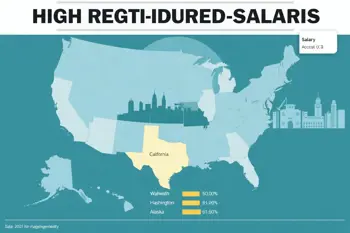
| State | Reported salary or estimate | Cost or tax consideration |
|---|---|---|
| Texas | Approximately $95,000 in one comparison | No state income tax and below-average living costs in the cited analysis |
| Tennessee | Approximately $80,000 | No state income tax and living costs reported below average |
| Washington | Approximately $111,000 in one ranking | No state income tax on wages, though Seattle is expensive |
| California | Approximately $137,000 to $145,000 | High state tax exposure and substantially elevated living costs |
Specialty and experience can outweigh state averages
State averages conceal substantial differences between nursing roles. The supplied specialty benchmarks place med-surg hospital RNs at a median base salary of $82,000, compared with $98,000 for ICU nurses, $95,000 for operating-room and labor-and-delivery nurses, $100,000 for NICU nurses, and $105,000 for cath-lab nurses. Travel RN compensation is listed from $85,000 to $115,000 for annualized med-surg contracts, with ICU contracts ranging from $105,000 to $140,000. 3
- Higher-paying specialty examples include cath lab, NICU, ICU, operating room, and labor and delivery.
- Clinic and school nursing generally report lower median base salaries than hospital specialties.
- Experience, credentials, shift differentials, overtime, and contract structure can change actual earnings.
- Advanced practice registered nurses typically earn more than staff RNs because of additional education and scope of practice.
Taxes, regulation, and employment risks
A salary comparison should also account for deductions, licensing requirements, staffing conditions, and the structure of employment. State income tax is only one factor because federal tax, FICA, housing, transportation, benefits, retirement contributions, and mandatory deductions affect take-home pay. Travel nursing can produce higher annualized figures, but contract availability and compressed travel rates create uncertainty. State averages likewise do not guarantee eligibility for a specialty role, acceptance of an out-of-state license, or access to a particular hospital pay scale. 4 6
- Verify whether a reported figure is a base salary, mean wage, median wage, or annualized contract total.
- Separate taxable wages from stipends, overtime, bonuses, and benefits.
- Review state licensure and employer-specific credential requirements before comparing positions.
- Consider staffing ratios, scheduling, workplace conditions, and housing costs alongside gross pay.
What the data suggests for relocation decisions
California offers the strongest nominal RN salary signal, while Hawaii, Oregon, Washington, Massachusetts, Alaska, and New York form a recurring high-pay group. Nurses prioritizing purchasing power may find Texas, Tennessee, Florida, Arizona, or North Carolina more competitive after taxes and living costs, even when their gross salaries are lower. The appropriate comparison depends on specialty, experience, household expenses, and tolerance for high-cost markets. 2 5
The central finding is that no single ranking answers every compensation question. Salary tables identify where employers report higher wages, but an informed assessment must distinguish state averages from individual offers and nominal income from real purchasing power. Regulatory conditions, union coverage, staffing shortages, taxes, housing, and professional qualifications all influence the final economic outcome for a registered nurse.
Sources
- Nurse.Org, “Nurse Salaries By State + the Highest Paying States 2026”
- RNWages, “Best States for RNs: Pay, Cost of Living, and Job Markets in 2026”
- Ava Health, “RN Salary by State 2026: Top-Paying States + Specialty”
- TakeHomeTax, “Registered Nurse Salary by State After Taxes (2026)”
- RelocateRight, “Top 10 Best States for Nurses in 2026”
- Nursa, “The 10 Best-Paying States for Registered Nurses in 2026”
Authored by 24Trendz team