Understand Hypertension Treatment Options: A Clinical Overview of Lifestyle, Medicines, and Monitoring
Understand Hypertension Treatment Options by looking at the two central components of care: sustained lifestyle changes and, when indicated, prescription medication. Current guidance emphasizes accurate repeated measurements, cardiovascular risk assessment, home monitoring, and individualized treatment rather than decisions based on a single reading. 1
How hypertension is classified and evaluated
The 2025 American Heart Association and American College of Cardiology framework defines normal blood pressure as below 120/80 mmHg, elevated blood pressure as systolic pressure from 120 to 129 mmHg with diastolic pressure below 80 mmHg, stage 1 hypertension as 130 to 139 or 80 to 89 mmHg, and stage 2 hypertension as at least 140 or 90 mmHg. Readings above 180/120 mmHg are categorized as hypertensive crisis and require clinical assessment, particularly when symptoms are present. 6
Diagnosis and treatment planning rely on repeated, accurate measurements, medical history, current medicines, other conditions, and home readings when appropriate. Home monitoring can help identify white-coat hypertension, in which office readings are higher, and can show whether treatment is controlling pressure outside the clinic. The 2025 guideline also adopts the PREVENT calculator for cardiovascular risk assessment, incorporating kidney function, statin use, and social drivers of health without using race as a variable. 3
Lifestyle treatment as the foundation
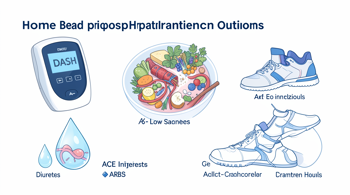
Lifestyle intervention is recommended for adults with elevated blood pressure and hypertension. Key measures include a DASH-style dietary pattern, sodium restriction, weight management, regular physical activity, limiting alcohol intake, avoiding tobacco, and addressing sleep and stress factors. StatPearls summarizes the 2025 guidance as recommending sodium below 1,500 milligrams per day and 150 minutes per week of moderate-intensity exercise. These measures may be used alone initially in selected lower-risk adults or alongside medication. 6
Lifestyle treatment is not a short course that ends when a reading improves. Dietary patterns, activity, alcohol intake, and weight management require continuing attention, while clinicians may use follow-up readings to determine whether the approach is sufficient. For adults with stage 1 hypertension and a PREVENT 10-year cardiovascular risk below 7.5%, the summarized guidance recommends a period of lifestyle modification lasting three to six months before medication is considered, provided there are no other indications for earlier pharmacotherapy. 6
First-line prescription medication classes
Four medication classes are identified as first-line options in the cited treatment guidance: angiotensin-converting enzyme inhibitors, angiotensin-receptor blockers, calcium-channel blockers, and diuretics. They lower pressure through different mechanisms, including relaxing blood vessels, changing hormone signals, and reducing excess salt and water. Selection depends on blood pressure severity, kidney function, diabetes, cardiovascular disease, pregnancy considerations, other medicines, occupation, and the side-effect profile relevant to the individual. 1
| Medication class | General role described in the research |
|---|---|
| ACE inhibitors | First-line option that changes hormone signaling and helps relax blood vessels. |
| ARBs | First-line option affecting hormone pathways that regulate vascular tone. |
| Calcium-channel blockers | First-line option that relaxes blood vessels. |
| Diuretics | Reduce excess salt and water, lowering fluid volume. |
| Beta-blockers | Generally not first-line for uncomplicated hypertension, but relevant with selected comorbidities. |
Medication effects may begin within hours or days, but determining the most appropriate dose and combination can take several weeks. Side effects vary by class and patient, and a clinician may need to adjust the regimen or try another class. Prescribed medication should not be stopped suddenly or changed without medical advice because blood pressure control can deteriorate. 89
When combination therapy is considered
Many adults require more than one medicine to reach a blood pressure target. Harvard Health reports that most adults with hypertension need at least two medications for control, while up to 30% require three, although the appropriate regimen depends on the person rather than a fixed formula. Stage 2 hypertension is commonly managed with combination therapy, and the 2025 guidance emphasizes selecting complementary drug classes and monitoring the response. 26
For difficult-to-control hypertension, the initial three-drug structure described in family medicine guidance includes a dihydropyridine calcium-channel blocker, an ACE inhibitor or ARB, and a thiazide diuretic. Before labeling the condition resistant hypertension, clinicians assess measurement errors, adherence, white-coat hypertension, secondary causes, and whether treatment has been optimized. This approach reduces the risk of adding medicines when the apparent lack of control results from inaccurate readings or an incomplete evaluation. 10
Special conditions and resistant hypertension
Treatment choices change when hypertension occurs with chronic kidney disease, diabetes, coronary disease, pregnancy, neurologic disorders, or suspected secondary causes. The updated guideline expands screening for primary aldosteronism to all patients with stage 2 or resistant hypertension. The review also describes a stronger focus on kidney function, home monitoring, team-based care, and tailored recommendations for special populations. These factors can affect both the choice of medication and the blood pressure target. 5
Resistant hypertension means blood pressure remains above goal despite optimal or maximum tolerated doses of three medicines, including a diuretic. Evaluation should include adherence, comorbid conditions, secondary hypertension, measurement technique, and confirmatory home monitoring. For selected patients whose pressure remains uncontrolled, renal denervation has been introduced as an adjunctive option in the 2025 guideline. It is not a replacement for careful diagnosis, medication optimization, and lifestyle management. 510
Monitoring, safety, and ongoing treatment realities
Hypertension is often silent, so symptom improvement is not a reliable indicator of control. Regular home readings and clinical follow-up allow clinicians to evaluate effectiveness, identify excessively low readings or adverse effects, and modify doses safely. Blood pressure treatment protects against long-term complications involving the heart, brain, kidneys, and eyes, but it requires continued maintenance even when a person feels well. 79
A reading above 180/120 mmHg is a serious finding. When accompanied by concerning symptoms, it requires urgent medical assessment rather than self-directed medication changes. Medication adherence, accurate cuff technique, interaction with other medicines, and screening for secondary causes are practical safety issues. Treatment decisions should also account for pregnancy and other special circumstances, because a medicine suitable for one patient may be unsuitable for another. 63
Sources
- 2025 AHA/ACC/AANP/AAPA/ABC/ACCP/ACPM/AGS/AMA/ASPC/NMA/PCNA/SGIM Guideline, Circulation
- Harvard Health, Taming high blood pressure: How doctors find the right drug mix
- Medscape, Hypertension, Adults: 2025 AHA/ACC Guideline Summary
- NCBI Bookshelf, NICE Guideline: Hypertension in adults: diagnosis and management
- Springer Nature, Updates in the 2025 AHA/ACC Hypertension Guideline
- StatPearls, Antihypertensive Medications: Treatment and Management
- Acibadem Hospitals Group, Hypertension Treatment: Early Signs, Risk Factors, and How It Is Treated
- Healthline, How Do Blood Pressure Medications Lower Blood Pressure?
- Acibadem Hospitals Group, Hypertension Treatment Medication: How It Works, Results and What to Expect
- American Family Physician, Resistant Hypertension in Adults: Evaluation and Treatment
Authored by 24Trendz team