Early symptoms of Raynaud's Disease you should know: A clinical guide to recognizing first signs
Recognizing the first color changes
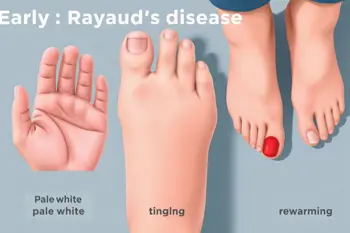
The most recognizable early symptom is a marked change in the color of a finger or toe during exposure to cold or emotional stress. The affected skin may turn white or pale as small blood vessels constrict and blood flow falls. It may then look blue or purple as oxygen levels in the tissue decrease. Not everyone experiences every color or the same sequence, so a pale or bluish episode that repeatedly follows a trigger can still be relevant. 1
Color changes may begin in one finger or toe and spread to other digits. The thumbs are typically unaffected in primary Raynaud's, although patterns can vary, and both hands or feet may not respond identically. A brief, occasional change caused by ordinary cold exposure can occur in anyone, but repeated, clearly visible changes accompanied by discomfort or delayed recovery are more characteristic of Raynaud's phenomenon than general cold hands. 2
Coldness, numbness, and tingling
During an attack, affected digits often feel unusually cold because the temporary vessel spasm reduces the delivery of warm blood to the skin. Numbness, pins and needles, prickling, or a sensation that the finger is temporarily “dead” may occur at the same time. Some people notice stiffness or reduced ability to move the fingers while the episode is active, which can make tasks involving the hands more difficult. 3
These sensations can be more noticeable than the color change, particularly when the skin tone makes pallor or blueness harder to distinguish. Raynaud's most often affects fingers and toes, but episodes may also involve the ears, nose, lips, or, less commonly, the nipples. The pattern is usually episodic rather than constant, with symptom-free periods that may last for long intervals between attacks. 1
What happens as circulation returns
Rewarming can produce a second group of early symptoms. As the vessels relax and blood flow returns, the skin may turn red, and the area can tingle, throb, sting, or ache. Redness is therefore not necessarily the beginning of an attack; it may represent the recovery phase. Pain can be especially noticeable when circulation returns quickly after a period of numbness or marked pallor. 2
An episode may last around 15 minutes, although reported duration ranges from a few minutes to several hours. The length can depend on the severity of the response and how quickly the affected area is rewarmed. The full three-color pattern is not required for recognition, and the order can differ. Tracking the trigger, body part, colors, sensations, and recovery time can provide useful information for a clinician. 3
Common triggers and early patterns
Cold is the most familiar trigger, including chilly outdoor temperatures, cold water, air conditioning, or handling a cold object. Emotional stress and anxiety can also provoke an attack because the small arteries may overreact to stress as well as temperature. A person may notice symptoms while holding a cold drink, reaching into a freezer, or moving between warm and cold environments. 2
Early attacks may be intermittent and separated by long periods without symptoms. Smoking can worsen circulation, while repeated vibration or trauma affecting an area has been associated with secondary Raynaud's. Certain medicines and environmental exposures may also contribute, but the provided clinical sources emphasize that triggers and severity differ among individuals. A recurring relationship between a specific exposure and color or sensory changes is more informative than a single isolated cold finger. 5
Primary and secondary Raynaud's
Primary Raynaud's develops without another known disease and is the more common form. It often begins between ages 15 and 30, occurs more frequently in women, and may affect several members of a family. Symptoms are commonly mild and many people manage them by reducing cold exposure, keeping the hands and feet warm, and using relaxation techniques during stress. Most people with primary Raynaud's do not develop tissue damage. 4
Secondary Raynaud's occurs alongside another health problem and tends to be less common but potentially more serious. Associated conditions include systemic sclerosis or scleroderma, lupus, Sjögren's syndrome, rheumatoid arthritis, other connective-tissue disorders, and some thyroid conditions. Secondary symptoms may begin later in life, become more severe, affect unusual areas, or involve an atypical pattern. These features do not establish a diagnosis, but they support medical evaluation for an underlying condition. 1
Signs that need medical assessment
Most attacks do not cause permanent injury, but severe or repeated reduction in blood flow can result in dry, cracked, or split skin, painful sores, ulcers, infection, or, in extreme cases, tissue death. New symptoms that are severe, worsening, persistent, or limited mainly to one side deserve assessment. Medical review is also appropriate when attacks interfere with hand movement or daily activities, occur without an obvious trigger, or appear for the first time later in adulthood. 7
Assessment is particularly important when color changes are accompanied by persistent pain, open sores, signs of infection, or evidence of another inflammatory or connective-tissue illness. Until evaluated, practical measures described by clinical sources include avoiding cold, using insulated gloves and socks, warming the whole body, and stopping smoking. Rewarming should be controlled rather than exposing numb skin to an extreme heat source, and persistent or damaged skin should not be self-diagnosed as uncomplicated primary Raynaud's. 3
Sources
- Yale Medicine, “Raynaud Phenomenon”
- Penn Medicine, “Raynaud’s Syndrome: Symptoms and Causes”
- NHS inform, “Raynaud’s phenomenon”
- FamilyDoctor.org, “Raynaud’s Disease”
- Arthritis Society Canada, “Raynaud’s Phenomenon”
- Arthritis Ireland, “Raynaud’s”
- Yale Medicine, “Raynaud Syndrome: It’s Not Just Cold Fingers and Toes”
Authored by 24Trendz team