Heat pump systems on sale: A Consumer's Guide to Market Pricing, Efficiency Ratings, and Buying Considerations
Consumers researching heat pump systems on sale will find a market that spans a wide range of configurations, efficiency tiers, and price points. From compact 2-ton ducted split systems priced near $2,600 to premium inverter systems exceeding $7,000, the category rewards buyers who understand efficiency ratings, refrigerant transitions, and the layered incentive structures that can significantly affect the total acquisition cost.
Understanding SEER2 Ratings and Why They Drive Pricing
The SEER2 rating is the federally mandated efficiency metric applied to all heat pump systems sold in the United States after January 2023. It replaced the older SEER standard with a more rigorous test protocol, meaning a 15 SEER2 unit represents a higher real-world efficiency level than a 15 SEER unit under the prior standard. Entry-level systems in the current market typically carry SEER2 ratings between 14 and 16, while high-performance inverter systems reach 20 SEER2 and above. The Bosch IDS Light Series 3-ton ducted system, for example, carries a 20 SEER2 rating and is listed at approximately $6,616 to $7,156 depending on configuration. 1 The ACIQ Extreme Series 3-ton system achieves a 17.4 SEER2 rating at a lower market reference price of around $4,399. 2
Energy Star certified heat pumps can reduce heating and cooling costs by 20% to 50% compared to conventional HVAC systems, making the efficiency rating a long-term financial variable, not just a specification number. 3 Buyers comparing systems purely on equipment price without accounting for projected operating cost differences risk undervaluing higher-efficiency units over a 10- to 15-year service horizon.
Current Market Pricing Across Major System Configurations
Ducted split systems, which pair an outdoor condenser with an indoor air handler, represent the dominant configuration for whole-home applications. The Hisense Hi-ULTRA HD 2-ton 16 SEER2 system using R-32 refrigerant is documented at a market reference price of $2,599, making it one of the lower entry points for a complete matched-component inverter system. 4 The MRCOOL VersaPro 2nd Gen 2.5-ton 17 SEER2 central ducted system using R-454B refrigerant has a listed reference price of $2,880. 5 Stepping up in capacity, the Goodman 3.5-ton 17.5 SEER2 premium inverter system with variable-speed air handler carries a market reference price range of approximately $5,825 to $6,084. 6
| Brand / Model | Capacity | SEER2 | Refrigerant | Market Reference Price |
|---|---|---|---|---|
| Hisense Hi-ULTRA HD | 2 Ton | 16 | R-32 | $2,599 |
| MRCOOL VersaPro 2nd Gen | 2.5 Ton | 17 | R-454B | $2,880 |
| MRCOOL Hyper Heat 2nd Gen | 3 Ton | 17.4 | R-454B | $3,679 |
| ACIQ Extreme Series | 3 Ton | 17.4 | R-454B | $4,399 |
| Goodman 3.5 Ton Premium Inverter | 3.5 Ton | 17.5 | R-32 | $5,825 – $6,084 |
| Bosch IDS Light Series | 3 Ton | 20 | R-454B | $6,616 – $7,156 |
Dual-Fuel and Hybrid System Pricing
Hybrid systems combine a heat pump condenser with a gas furnace, allowing the furnace to handle heating loads during extreme cold while the heat pump manages moderate-temperature heating and all cooling. The Goodman 3-ton 15.2 SEER2 system paired with an 80% AFUE 80,000 BTU furnace carries a market reference price of $5,208. 7 The ACiQ Extreme Series 3-ton 15.8 SEER2 system bundled with an 80% AFUE 80,000 BTU Low NOx furnace is documented at $4,669, pairing an inverter heat pump condenser with a two-stage gas furnace. 8 At the high-efficiency end, the ACiQ hybrid 3.5-ton 15.2 SEER2 system with a 96% AFUE 100,000 BTU two-stage furnace is listed at $6,130.99. 9
Hybrid configurations are well-suited to climates that experience genuine cold snaps, as the gas furnace provides faster temperature recovery and stronger heating capacity at low ambient temperatures. The trade-off is a more complex installation requiring both gas line work and electrical connections, along with two sets of maintenance obligations. Buyers in moderate climates who rarely see sustained temperatures below 20°F may find all-electric inverter systems more cost-effective over the system's lifetime.
Ductless Mini-Split Systems: Multi-Zone Pricing
Ductless mini-split systems bypass existing ductwork by connecting an outdoor condenser directly to wall-mounted or ceiling-cassette air handlers in individual rooms. Multi-zone configurations allow a single outdoor unit to serve multiple interior zones. The Daikin MXM 24,000 BTU 3-zone 21 SEER2 wall-mount system using R-32 refrigerant carries a market reference price of approximately $5,696. 10 The ACiQ Extreme 27,000 BTU 2-zone 23 SEER2 system using R-454B is documented at $4,499. 11 The Daikin 36,000 BTU 4-zone 20 SEER2 system at 230V is referenced at $7,288. 12
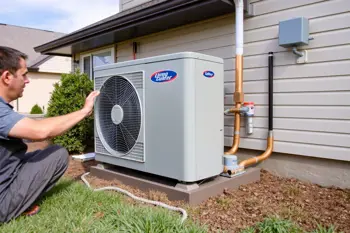
Mini-split pricing must account for line set costs, which add $245 to $587 per zone depending on run length, as well as professional installation labor that varies significantly by region. Systems certified for hyper-heat operation, meaning sustained performance down to -22°F or below, generally carry higher condenser prices due to enhanced compressor technology. Buyers in cold climates should verify the minimum operating temperature specification, as non-hyper-heat models experience substantial capacity loss below 5°F.
Federal Tax Credits, Utility Rebates, and Net Cost Considerations
The Inflation Reduction Act provides a federal tax credit of 30%, up to $2,000 annually, for the installation of qualifying high-efficiency heat pumps, which is claimed on IRS Form 5695 when filing annual income tax returns. 13 This credit is non-refundable, meaning it can offset tax liability but does not generate a refund beyond what is owed. Heat pump unit sales in the United States surpassed gas furnace sales for the first time in 2022, reflecting the combined effect of improved cold-climate performance and growing consumer awareness of these financial incentives. 14
State-level programs extend the financial picture further. New York's NYSERDA program and California's TECH Clean California initiative provide additional financial assistance beyond federal credits. 15 Many local utility companies offer rebates ranging from $500 to $2,000 for homeowners switching to electric heat pump systems. 16 Buyers can search for utility-specific rebates through the Energy Star rebate finder database, which catalogs programs by ZIP code. 17 It is important to verify eligibility criteria for each program independently, as minimum SEER2 and HSPF2 thresholds, equipment certification requirements, and income limits vary by program and jurisdiction.
Installation Costs, Sizing Risks, and Ongoing Maintenance
Equipment pricing represents only a portion of the total project cost. A residential ducted heat pump installation typically requires professional refrigerant handling, electrical work including a dedicated circuit and disconnect switch, ductwork inspection or modification, and system commissioning. Shipping costs for equipment add $65 to $250 or more depending on delivery location, with western states often carrying a freight surcharge. 4 Heater kit add-ons for air handlers range from approximately $99 to $326 depending on kilowatt capacity and brand. 6
Undersizing or oversizing a heat pump relative to the home's actual load creates persistent comfort and efficiency problems regardless of the system's rated efficiency. A properly performed Manual J load calculation by a licensed HVAC contractor is the standard method for determining correct tonnage. Seasonal maintenance obligations include annual refrigerant pressure checks, coil cleaning, filter replacement, and condensate drain inspection. Inverter-driven systems, while more efficient, contain more complex electronics that require technicians familiar with variable-speed diagnostics. Manufacturer warranties on matched-component systems vary by brand but typically cover compressors for 5 to 10 years when registered within a specified window after installation.
Refrigerant Transitions and Long-Term Serviceability
The residential HVAC market is actively transitioning away from R-410A toward lower global-warming-potential refrigerants. The dominant replacement refrigerants appearing in current market listings are R-32 and R-454B. The Goodman packaged heat pump unit GPHM53631 at 15.2 SEER2 uses R-32, while numerous MRCOOL, ACiQ, and Bosch systems have moved to R-454B. 18 Buyers purchasing systems with older R-410A refrigerant should be aware that long-term service costs may increase as R-410A availability and technician authorization requirements evolve under EPA phasedown regulations.
R-454B is classified as mildly flammable (A2L classification), a factor that requires technicians to hold updated EPA 608 certification and use appropriate handling equipment. R-32 carries the same A2L classification. These refrigerant characteristics do not affect occupant safety during normal system operation but do affect who can legally service the equipment. Verifying that a qualified local service contractor is available before purchasing a system using these newer refrigerants is a prudent step that many buyers overlook when evaluating equipment costs in isolation.
Sources
- HVACDirect.com – Bosch IDS Light Series 3 Ton 20 SEER2 Product Listings
- HVACDirect.com – ACIQ Extreme Series 3 Ton 17.4 SEER2 Product Listing
- ENERGY STAR – Heat Pump Efficiency and Federal Tax Credits Overview (energystar.gov)
- HVAC.place – Hisense Hi-ULTRA HD 2 Ton 16 SEER2 Heat Pump System Product Page
- HVACDirect.com – MRCOOL VersaPro 2nd Gen 2.5 Ton 17 SEER2 Product Listing
- HVAC.place – Goodman 3.5 Ton 17.5 SEER2 Premium Inverter Heat Pump System Product Page
- HVACDirect.com – Goodman 3 Ton 15.2 SEER2 80% AFUE 80,000 BTU Furnace and Heat Pump System
- HVACDirect.com – ACiQ Extreme Series 3 Ton 15.8 SEER2 80% AFUE Furnace and Heat Pump System
- HVACDirect.com – Hybrid 3.5 Ton 15.2 SEER2 96% AFUE ACIQ Furnace and Heat Pump System
- ChillMiniSplits.com – Daikin MXM 24,000 BTU 3-Zone 21 SEER2 Mini Split System
- HVACDirect.com – ACiQ Extreme 27,000 BTU 23 SEER2 2-Zone Wall Mount Mini Split System
- HVACDirect.com – Daikin 36,000 BTU 4-Zone 20 SEER2 Wall Mount Mini Split System
- Internal Revenue Service – Energy Efficient Home Improvement Credit (irs.gov)
- Canary Media – Heat Pump Sales Surpassed Gas Furnace Sales in 2022 (canarymedia.com)
- Rewiring America – IRA Calculator for State and Federal Heat Pump Incentives (rewiringamerica.org)
- U.S. Department of Energy – Heat Pump Systems Overview (energy.gov)
- ENERGY STAR – Rebate Finder Database (energystar.gov)
- HVACDirect.com – Goodman GPHM53631 3 Ton 15.2 SEER2 Packaged Heat Pump Unit Product Listing
Authored by 24Trendz team