Review of tactical transport military equipment stocks: logistical documentation and payload weight details
Analysts reviewing tactical transport military equipment stocks consistently find that payload weight ratings and logistical documentation standards are the two variables that most directly determine whether a platform succeeds in the field. From medium-duty ground trucks moving ammunition pallets to intercontinental airlifters delivering armored vehicles, every asset in the military transport inventory carries a defined weight limit, a documentation trail, and a set of regulatory standards that govern how it is tracked, maintained, and deployed. Understanding how these elements interconnect provides a clearer picture of where modern military logistics stands and where it is heading.
Ground Transport: Payload Tiers and Platform Differentiation
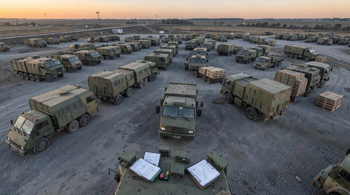
The U.S. Army's tactical ground transport inventory operates across clearly defined payload tiers. The Family of Medium Tactical Vehicles, commonly known as the FMTV, covers the 2.5-to-5-ton payload class and entered fielding in 1996 as a replacement for aging M35 and M809 series trucks. 1 The cargo variant of the Medium Tactical Vehicle can handle payloads ranging from 6,000 to 10,000 pounds for forward supply operations and ammunition transport, making it a central node in distribution from logistics points to company-level elements. 2 Procurement remains active, with the U.S. Army's FMTV A2 program valued at USD 214.8 million reflecting continued fleet recapitalization priorities. 3
At the heavier end of the ground spectrum, the Heavy Expanded Mobility Tactical Truck (HEMTT), developed by Oshkosh Defense and fielded from 1982, provides the core heavy-lift ground capability for American forces. The platform was designed specifically to sustain high-tempo armored operations, keeping pace with M1 Abrams and M2 Bradley formations across broken terrain rather than relying on road infrastructure. 4 The Palletized Load System, derived from HEMTT drivetrain architecture and produced from 1993, advances this further by moving up to 33,000 pounds of cargo using an onboard load-handling system that eliminates the need for external forklifts or cranes at forward positions. 5 This self-loading capability was a direct response to bottlenecks observed at forward operating bases during Cold War-era planning exercises.
Heavy Dump and Engineering Support: The Mack M917A3 Documentation Case
The Mack M917A3 Heavy Dump Truck illustrates how logistical documentation requirements scale with platform complexity. In July 2026, the U.S. Army ordered 115 additional M917A3 units for the Army National Guard under a 2025 contract covering up to 450 trucks, with an earlier fiscal year 2026 purchase of 91 vehicles already on record. 6 Each M917A3 carries a gross vehicle weight rating of 94,500 pounds, a 243-inch wheelbase, and a payload rating of up to 27 tons (54,000 pounds). The Crysteel dump body holds 18 cubic yards, expandable to 22 cubic yards with sideboards. 6
A critical documentation note for platforms of this class is that payload weight rather than volume becomes the limiting constraint when hauling dense materials such as crushed rock or wet soil. The M917A3's material-control system permits regulated discharge through the tailgate, and a heated body maintains asphalt workability during transport, each of which requires specific operator documentation during route and mission planning. 6 Military Standard MIL-STD-209K governs lifting and tie-down requirements across all such platforms, establishing the documentation baseline for transport stability compliance. 7
NATO-Aligned European Platforms: Tatra Fleet Technical Specifications
European NATO contributors maintain parallel equipment stocks anchored by Czech manufacturer Tatra Trucks. The Tatra 815 family, available in configurations from 4x4 through 12x12, carries a gross weight of up to 35,500 kg (78,264 lb) and uses the brand's signature central backbone tube chassis with independently suspended swinging half-axles. 8 The Tatra 815-7, in production since 2007 and also designated T817 or Tatra Force, offers engine options including air-cooled Tatra V8 turbodiesels producing up to 368 kW (493 hp) and V12 units up to 515 kW (691 hp), alongside liquid-cooled Cummins engines up to 447 kW (599 hp). Curb weight is 13,300 kg (29,300 lb). 9
The Tatra 810, designed as the Czech Army's medium logistics vehicle to replace the Cold War-era Praga V3S, entered serial delivery from 2008 after an initial order of 556 units placed in 2007. Its payload capacity reaches 5.2 tonnes with a full permissible mass of 14 tonnes and a maximum trailer weight of 12 tonnes. 10 The modernized Tatra 810 M variant, unveiled at the IDET defense exhibition, retains the ladder frame and portal rigid Tatra axle architecture while improving the front suspension with coil springs, a roll stabilizer, and telescopic dampers. 11 NATO interoperability standards and STANAG agreements define the dimensional and weight-limit labeling requirements these platforms must meet for multinational equipment movement. 12
Strategic and Tactical Airlift: Payload Capacity by Platform
Air transport assets complete the logistics chain for equipment that cannot reach forward areas by ground. The Boeing C-17 Globemaster III, in service from 1995, holds a maximum payload of 170,900 pounds (77,519 kg) and a maximum takeoff weight of 585,000 pounds (265,352 kg). With 279 total units built, it serves as the primary intercontinental airlifter for the U.S. and allied forces, capable of landing on runways as short as 3,500 feet while carrying M1 Abrams main battle tanks. 13 The C-17's cargo floor measures 88 feet in length and 18 feet in width, providing 1,584 square feet of usable deck space. 14 Canada's planned USD 540 million sustainment package for its five CC-177 Globemaster III aircraft, announced in May 2026 with Boeing as principal contractor, underscores the long-term documental and maintenance commitment these platforms require. 15
The Lockheed C-5M Super Galaxy, with a maximum payload of 281,000 pounds (127 metric tons), sits above the C-17 in gross capacity and can accommodate two M1 Abrams tanks or 270,000 pounds of supplies, with only 52 C-5Ms remaining after modernization. 16 The Airbus A400M Atlas, a NATO-aligned option, carries a certified payload of 37 tonnes with upgrade potential to 40 tonnes and a cargo bay of 340 cubic metres, making it compatible with light armored platforms such as India's evaluated Zorawar Light Tank. 17 The CH-47F Chinook helicopter bridges the gap to rotary-wing transport, with a maximum internal payload of approximately 24,000 pounds, supported by a tandem rotor design that eliminates the torque overhead imposed by a tail rotor and directs all engine power to lift. 18
Logistical Documentation Frameworks and Inventory Tracking
Military logistical documentation governing tactical transport equipment stocks operates through interconnected regulatory layers. The Defense Transportation Regulation 4500.9-R serves as the authoritative source for U.S. Department of Defense logistical documentation requirements across all transport modes. 19 The Department of the Air Force Manual 23-300, incorporating Change 1 as of February 2026 and certified under Major General Elizabeth E. Arledge, provides the baseline supply chain materiel management procedures for Air Force assets and applies to Regular Air Force, Space Force, Reserve, and Air National Guard materiel managers. 20 Inventory tracking of ground vehicle stocks operates through the Global Combat Support System (GCSS-Army), which provides real-time visibility into tactical equipment status and logistics readiness. 21
Movement documentation for oversized and sensitive assets follows additional layers of compliance. Transport of missile transporters and equivalent military-grade equipment requires asset evaluation covering size, weight, height, width, and center of gravity per MIL-STD-209K, followed by route and permit planning. 7 The Joint Flow and Analysis System for Transportation (JFAST) serves as the primary analytical software suite for military deployment movement requirements, while the Total Ammunition Management Information System (TAMIS) provides digital oversight for hazardous materiel transport logistics. 2 NATO STANAG documentation standards extend these requirements to multinational contexts, governing dimensional and weight-limit labeling for cross-border equipment transfers. 12
Market Scale, Risks, and Operational Constraints
The military transport market was estimated at USD 24.14 billion in 2026, with projections reaching USD 32.23 billion by 2031 at a 5.92% compound annual growth rate. The military logistics market, a broader category, stood at USD 27.7 billion in 2025 and is projected to reach USD 58.2 billion by 2035 at a 7.71% CAGR, with North America as the largest market and Asia-Pacific as the fastest growing. 22 Fleet recapitalization, hybrid-electric propulsion adoption, and AI-enabled maintenance software are cited as key accelerators. A practical illustration of demand flexibility came through 8.7 million kg of humanitarian aid moved to Gaza via the U.S. Joint Logistics Over-the-Shore pier, demonstrating how military transport assets carry dual-use civilian emergency obligations. 3
Operational constraints and procurement risks deserve equal analytical weight. Payload ratings frequently conflict with protection requirements: adding armor to cab chassis trucks reduces available payload and raises gross vehicle weight, creating documentation discrepancies if not recalculated and formally updated in platform records. Military cab chassis trucks must sustain operations across temperature extremes from minus 32 degrees Celsius to plus 55 degrees Celsius and withstand shock loads exceeding 15g during rapid deceleration events, conditions that accelerate maintenance cycles beyond civilian norms. 23 Emerging unmanned cargo platforms such as the Pyka DropShip, which claims a manufacturer-stated maximum takeoff weight of 1,600 lb (726 kg) and a payload of 500 lb (227 kg) over ranges exceeding 1,000 miles, introduce new documentation gaps: testing conditions, empty weight, and powertrain architecture details remain publicly undisclosed at the military evaluation stage, creating verification challenges for procurement offices assessing platform claims against MIL-STD requirements. 24
Sources
- militaryvehiclesvault.com - HEMTT vs FMTV: Why the Army Needs Both Trucks
- U.S. Army Field Manual / Army Sustainment Magazine - MTV and PLS Payload Specifications
- mordorintelligence.com - Military Transport Market Size and Share Outlook to 2031
- militaryvehiclesvault.com - HEMTT: The Army Heavy Truck That Moves Everything
- militaryvehiclesvault.com - PLS Palletized Load System Guide
- armyrecognition.com - U.S. Army Orders 115 Mack M917A3 Trucks for National Guard
- beardown-logistics.com - How to Move Missile Transporters and Military Assets (MIL-STD-209K)
- handwiki.org - Engineering: Tatra 815
- en.wikipedia.org - Tatra 815-7
- technicalparameters.eu - Tatra 810 Technical Parameters
- transportminutes.eu - Tatra 810 M Modernization
- NATO NSO - STANAG Standardization Agreements for Logistical Documentation
- thedefensepost.com - C-17 Globemaster III: The Airlifter That Changed Modern Military Logistics
- c17pilot.com - Everything the C-17 Globemaster Can Carry
- avioblog.it - US Approves $540M Canada C-17 Globemaster Sustainment Package
- aircraftinsider.com - Top 8 Military Transport Aircraft: Payload and Range Analysis
- indiandefensenews.in - A400M vs Kawasaki C-2: Airlift Solutions
- militarymachine.com - CH-47 Chinook Heavy-Lift Deep Dive
- U.S. Transportation Command - Defense Transportation Regulation 4500.9-R
- static.e-publishing.af.mil - DAFMAN 23-300 Materiel Management Procedures
- Defense Logistics Agency / Army Technology - GCSS-Army Inventory Tracking
- marketresearchfuture.com - Military Logistics Market Report
- sinotruckexp.com - Military Cab Chassis Trucks: Rugged, STANAG-Compliant and R&D-Backed
- sansu.pro - Pyka DropShip Hybrid Cargo UAS Analysis
Authored by 24Trendz team