How to evaluate used military workshop equipment for sale in the United States: A Practical Due-Diligence Framework
Evaluating used military workshop equipment for sale in the United States requires a structured review of condition, documentation, technical compatibility, and auction obligations. Government surplus may include scientific equipment, heavy machinery, vehicles, and other personal property, but the purchaser must study the applicable sale terms and inspect the asset as carefully as possible before committing funds. 1
Confirm the sale channel and legal terms
Federal surplus personal property can be offered to the public through GSA Auctions when agencies and eligible public or nonprofit recipients do not require it. State and local agencies may also place surplus assets on platforms such as GovDeals, which presents government inventory and location-search functions. These channels are distinct from private industrial auctions, so the seller, governing terms, inspection arrangements, and payment process should be identified for each lot. 1 3
Sale conditions are central to risk assessment. GSA states that used personal property is sold under the U.S. Government's Standard Form 114C, while each invitation for bid may contain additional notices or special terms. A purchaser should establish whether the lot is sold as-is, where-is, whether loading is included, and which party bears inspection, removal, transportation, and restoration responsibilities. GSA also identifies wire transfers, government checks, and major credit cards as payment methods, with a stated $24,999.99 credit-card limit. 1
Verify identity, provenance, and configuration
The data plate is a primary identity record. It can show the manufacturer, model, serial number, electrical requirements, date information, and other specifications needed to compare the physical asset with the auction description. Military-origin equipment may also carry National Stock Numbers, contract information, or government labeling, although such markings do not by themselves establish current operating condition. The serial number should remain consistent across the machine, documentation, accessories, and any included control cabinet. 7
Configuration matters because a workshop machine is rarely only a main frame. A complete system may require controls, tooling, fixtures, cooling equipment, extraction, guarding, cables, or specialized accessories. Appraisal reporting on machine shops notes that overhead cranes, hoists, runway tracks, tool cabinets, fixtures, carbide inserts, and precision inspection tools can represent material supporting assets that are easily overlooked. Each component should therefore be listed separately, with missing items treated as a functional limitation rather than an administrative detail. 5
Inspect mechanical and precision condition
For machine tools, inspection should begin with the spindle, bearings, ball screws, tool-change mechanism, way covers, visible rust, and fluid leaks. The overall physical condition provides evidence about wear and likely repair exposure, but appearance is not a substitute for a performance test. Maintenance logs and service records are valuable because they can show recurring repairs, replacement intervals, and periods of inactivity. Their absence should increase uncertainty in the evaluation rather than be treated as evidence of proper maintenance. 2
Accuracy and repeatability are especially important for lathes, mills, CNC machines, and other precision assets. A suitable inspection may include machine movement checks, spindle operation, tool changes, lubrication delivery, coolant circulation, and test cuts where site rules and equipment access permit. American Machinist identifies accuracy assessment and test cuts as important ways to confirm precision and repeatability. A machine that powers on but cannot hold required tolerances may require controls, mechanical alignment, or tooling work before production use. 2
Check electrical, hydraulic, and utility requirements
Workshop equipment often depends on infrastructure that is not visible in listing photographs. The data plate should be compared with the intended facility's voltage, amperage, phase, frequency, and connection capacity. Used equipment can require industrial power, including three-phase 480-volt service, while smaller or residential workshops may not have compatible electrical systems. Installation planning should also account for floor space, access routes, lifting capacity, ventilation, compressed air, coolant handling, and any required exhaust or fume extraction. 6
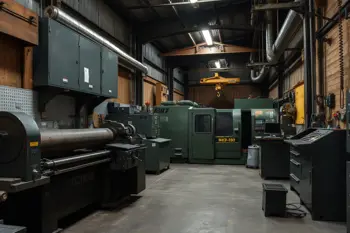
Electrical inspection should cover control cabinets, wiring condition, switches, motors, alarms, and evidence of water or heat damage. Mechanical equipment should be checked for hydraulic leaks, pressure stability, pump noise, and cylinder or hose deterioration where applicable. American Machinist specifically identifies electrical systems, lubrication, and coolant systems as inspection areas. Mac-Tech's guidance for used fiber-laser equipment adds enclosure interlocks, lockout/tagout readiness, ambient conditions, condensation risk, and optics contamination to the acceptance review. 2 8
Assess safety, maintenance, and operational risk
Military specifications may indicate that an asset was designed for demanding service, but they do not remove civilian workplace responsibilities. Guarding, emergency stops, interlocked openings, electrical isolation, and hazardous-energy procedures should be evaluated before operation. For laser equipment, safety documentation should explain enclosure behavior and monitored openings, while maintenance documentation should identify energy sources and servicing steps that can be mapped to lockout/tagout procedures. Missing safety documentation can complicate commissioning and employee training. 8
Maintenance planning should identify proprietary controls, obsolete electronics, special tools, unusual consumables, and sources for replacement parts. A pre-owned laser welding system, for example, may include a laser generator, beam-delivery components, a welding head, controller, chiller, and fume-extraction connections. If one of these components is absent or incompatible, the apparent machine value may not reflect the cost of returning the system to service. Installation guidance, manuals, and transport-environment requirements should be requested whenever they exist. 9
Calculate value and total ownership exposure
Assessment should separate the asset's observed condition from its market value. Machinery and equipment valuation commonly uses the cost approach, market approach, and income approach. For operating machinery, comparable market transactions are generally emphasized, with replacement cost less depreciation providing supporting context. Relevant factors include age, condition, technological obsolescence, manufacturer and model rarity, remaining useful life, location, and whether the equipment is specialized or widely interchangeable. 10
The financial calculation should include more than the winning bid or negotiated amount. Potential additions include buyer's premiums, taxes where applicable, inspection travel, electrical work, rigging, disassembly, loading, heavy-haul transport, storage, installation, commissioning, tooling, training, repairs, and ongoing maintenance. Auction guidance emphasizes that buyers should understand special terms, while industrial auction practice commonly requires advance planning for previews, removal, and transportation. A written maximum ownership figure provides a clearer decision standard than a bid based only on the machine's visible condition. 1 4
Use a documented inspection decision
A defensible evaluation file should contain the listing, photographs, data-plate details, serial number, configuration list, measurements, test results, maintenance records, utility requirements, safety documents, transport assumptions, and all identified defects. Each uncertainty should be classified as verified, conditionally acceptable, or unresolved. The classification is useful because government and industrial auction descriptions may not provide the same level of technical detail, and an online photograph cannot confirm precision, electrical integrity, or hidden corrosion. 1 3
The final decision should distinguish operational suitability from resale or appraisal value. A machine can have recognizable military provenance yet remain unsuitable because of missing accessories, incompatible power, obsolete controls, safety deficiencies, or excessive restoration exposure. Conversely, a heavily used asset may remain serviceable when inspection confirms precision, functioning systems, complete documentation, and maintainable components. The most reliable conclusion is therefore a documented comparison between verified capability, required repair scope, ownership logistics, and comparable used-equipment evidence. 2 10
Sources
- GSA, How to purchase surplus property: https://www.gsa.gov/buy-through-us/government-property-for-sale-or-lease/office-of-personal-property-management/for-citizens-seeking-surplus-property/how-to-purchase-surplus-property
- American Machinist, Inspection Tips for Machinists and Managers Buying Used CNC Machines: https://www.americanmachinist.com/shop-operations/article/55338283/inspection-tips-for-machinists-and-managers-buying-used-cnc-machines-shop-operations
- GovDeals, Government Surplus Auctions: https://www.govdeals.com/en
- Grafe Auction, Manufacturing Equipment Auctions: A Buyer's Guide: https://grafe-auction.ghost.io/manufacturing-equipment-auctions-what-industrial-buyers-need-to-know/
- US Asset Appraisals, 5 Things Inexperienced M&E Appraisers Miss in Machine Shops: https://www.usassetappraisals.com/blog-machinery-equipment-appraisal-news/5-things-inexperienced-mampe-appraisers-miss-in-machine-shops
- Manustructix, Used Machines for Small Workshops or Manufacturing: https://manustructix.com/used-machines-for-small-workshops-or-manufacturing-what-to-check-before-buying/
- Smiths Surplus, Military Surplus Gear: 10 Things to Know: https://smithssurplusandsupply.com/military-surplus-guide/
- Mac-Tech, Buying Used Fiber Laser Cutting Equipment: https://mac-tech.com/metal-fab-equip/buying-used-fiber-laser-cutting-equipment-safety-interlocks-loto-and-condensation-checks/
- CNCBUL, From Inspection to Installation: Used Amada Miyachi Jupiter 68P0070: https://www.cncbul.com/from-inspection-to-installation-what-to-verify-before-buying-a-pre-owned-used-secondhand-surplus-amada-miyachi-jupiter-68p0070-laser-welding-system-made-in-japan/
- CT Acquisitions, Machinery and Equipment Valuation: https://ctacquisitions.com/machinery-and-equipment-valuation/
Authored by 24Trendz team