Best Rated Robot Vacuums for Pet Owners: An Analysis of Market Performance and Technical Capabilities
Understanding Robot Vacuum Performance in Pet-Heavy Households
Managing pet hair and dander remains a primary challenge for automated home maintenance, with approximately 67% of U.S. households owning at least one pet 4. Research indicates that dog owners spend an average of 4.2 hours per week on manual hair cleanup, a figure that increases significantly during peak shedding seasons for breeds like German Shepherds and Huskies 7. High-performance robot vacuums designed for these environments must balance raw suction power with intelligent obstacle avoidance to navigate around pet toys, food bowls, and potential accidents 3. Modern testing protocols now prioritize metrics such as pickup rates across hardwood, tile, and carpet, alongside tangle resistance for various fur types 7.
The efficacy of these devices depends heavily on their mechanical design, specifically the brush roll system. Models utilizing dual rubber extractors generally outperform traditional bristle designs by agitating carpet fibers more effectively and reducing the frequency of manual brush cleaning 4, 10. Furthermore, the integration of HEPA filtration has become a critical requirement for households managing pet allergies, as these filters are engineered to capture dander particles as small as 0.3 microns 9. Devices that lack robust filtration or struggle with suction consistency often fail to maintain long-term cleaning performance in homes with high volumes of shedding 7.
Core Technologies for Pet Hair Management
The market for robot vacuums in 2026 features several technological advancements specifically aimed at pet-related obstacles. Reactive obstacle avoidance and AI-driven vision systems are increasingly common, allowing units to identify and steer clear of solid pet waste, which is a critical necessity for indoor pet safety 4, 5. The Roborock S8 MaxV Ultra, for instance, has demonstrated success in these categories by combining 10,000 Pa suction with ReactiveAI 2.0 obstacle recognition, effectively minimizing the risk of spreading debris during cleaning cycles 4.
Brush roll innovation also differentiates top-tier models from entry-level alternatives. Systems such as Shark’s self-cleaning brush rolls utilize mechanical combs to continuously remove hair during operation, while other manufacturers have opted for rubber-flex materials that naturally resist hair accumulation 9, 10. When selecting a device, users should consider the following comparative metrics derived from recent testing performance:
| Feature | Importance for Pet Owners | Performance Impact |
|---|---|---|
| Suction Power | High (6,000+ Pa recommended) | Deep cleaning of embedded fur in carpets |
| Brush Design | Anti-tangle / Rubber rollers | Reduced manual brush maintenance frequency |
| Base Station | Self-emptying / Self-washing | Hands-free automation over long periods |
| Filtration | HEPA Certification | Reduction of airborne dander and allergens |
Evaluating Performance Across Floor Types
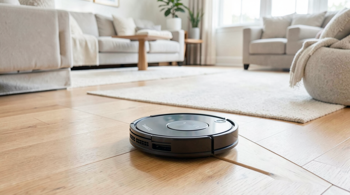
Testing environments reveal that performance on hardwood floors often differs significantly from carpeted surfaces. On hard floors, high-airflow vacuums excel at collecting surface hair, but may struggle with static-charged clumps if the bin capacity is insufficient 2. For carpets, deep extraction is the primary challenge; machines must provide enough agitation to dislodge pet hair woven into low or medium-pile fibers without stalling the motor 6. The Roborock Qrevo S5V has been noted for reaching 98% visibility removal in testing, attributed largely to its 12,000 Pa suction rating and specialized zero-tangle brush system 3.
Mopping capabilities also present a mixed performance landscape. While many newer models feature automated mop washing and warm-air drying to mitigate odors from wet pet mess, the effectiveness of the scrubbing mechanism varies 3. Models like the Ecovacs Deebot X8 Pro Omni demonstrate that while roller-mop designs are effective for edge-to-edge cleaning, they require careful calibration for optimal results on different floor materials 9. Effective transitioning between mopping and vacuuming, such as detaching mops when approaching carpeted zones, is essential to prevent the cross-contamination of dirt or hair onto dry surfaces 5.
Maintenance Realities and Long-term Costs
Owning a robot vacuum in a pet-heavy household involves ongoing maintenance beyond routine emptying. While self-emptying base stations significantly reduce the labor required, they introduce the need for periodic bag or filter replacements 4, 8. Consumers should anticipate that even the most advanced units require regular inspection of sensors, side brushes, and wheels, as pet hair can accumulate in these areas despite 'tangle-free' claims 3. Estimates suggest that maintenance is most frequent in households with multiple shedding animals, where debris can clog internal pathways if the bin capacity is not sufficiently large 6.
The cost of ownership extends to the replacement of consumable parts. Brushes, filters, and mop pads have specific lifespans that shorten in demanding pet environments. Budget-friendly models, such as the Eufy Omni C28 or the Dreame D10 Plus Gen 2, may provide effective initial performance but can occasionally require more frequent manual intervention to clear larger clumps of hair that premium units might handle internally via larger bins and more powerful suction 1, 2. Analyzing the long-term running costs is as vital as evaluating the initial hardware purchase price 3.
Navigational Accuracy and Smart Home Integration
Modern robot vacuums rely on sophisticated mapping technologies, including LiDAR and vision-based AI, to navigate around obstacles such as pet toys and furniture legs 5, 8. High-end models often allow users to designate 'no-go' zones within a companion app, which is a valuable feature for keeping vacuums away from sensitive areas like pet food bowls or designated resting spots 4. Connectivity with smart home ecosystems like Alexa, Siri, and Google Home provides additional utility, enabling scheduled cleaning cycles when the home is unoccupied to avoid disturbing pets 1.
Noise sensitivity is another factor frequently cited in consumer feedback. While high-suction modes are necessary for deep cleaning, they inevitably increase the decibel output of the unit 4. Many manufacturers address this by including 'Quiet Mode' settings that reduce motor intensity while maintaining enough power for surface-level hair collection. Evaluating the balance between navigation speed, noise levels, and cleaning intensity is necessary for selecting a model that fits both the household's layout and the pets' comfort levels 5.
Summary of Selection Considerations
When reviewing the market of available robot vacuums, there is no single model that performs perfectly across all possible household conditions. Potential users should prioritize models with proven high-suction capabilities, tangle-resistant brushes, and robust filtration systems 6, 10. The choice often comes down to a trade-off between premium features like advanced obstacle avoidance and total mopping automation, and the relative simplicity and cost-effectiveness of more standard models 1, 9. By matching the technical specifications of a device to the specific shedding patterns and floor types present in the home, pet owners can significantly reduce the burden of daily floor care 7.
Sources
- Tom's Guide: Best robot vacuums for pet hair 2026
- SlashGear: 5 of the best robot vacuums for pet hair in 2026
- GuideSpot: Best robot vacuums for pet hair tested and reviewed
- The Consumer's Guide: 10 best robot vacuums for pet hair
- Best Robot Vacuums: Roborock S8 MaxV Ultra review
- Best Vacuum Expert: 15 best rated robot vacuums for pet hair
- Ordoh: Robot vacuums for dog hair testing
- Best Robot Vacuums: Eufy E25 Omni review
- Best Robot Vacuums: Ecovacs Deebot X8 Pro Omni review
- Best Pick Guide: Shark Matrix Plus AV2410WD review
Authored by 24Trendz team