Ex-military trucks and vehicles for commercial use
Market Overview: Ex-military trucks and vehicles for commercial use
Ex-military trucks and vehicles for commercial use have long attracted fleet operators, construction firms, logistics providers, and specialist transporters seeking robust platforms at accessible entry prices. Auction data and surplus dealer listings consistently show headline bid prices sitting 20% to 50% below equivalent civilian-used units, though that gap frequently narrows once recommissioning, compliance work, and parts replacement are factored in. 1 Understanding the full lifecycle cost over a 3-year to 7-year operational window is therefore the central analytical task for any procurement team evaluating this category.
The global surplus vehicle pipeline draws from multiple sources. In the United States, the Defense Logistics Agency (DLA) Disposition Services manages federal surplus property including vehicles, making inventory available through authorized channels such as GovPlanet, GovDeals, and GSA Auctions. 2 In the United Kingdom, the Ministry of Defence releases vehicles through specialist dealers, with platforms like ExArmyUK and GPSV among the documented suppliers of ex-MoD cargo trucks, tankers, and plant equipment. Across continental Europe, Swiss Army, Dutch Army, and Bundeswehr surplus units circulate through international dealers with global shipping capabilities.
Key Vehicle Categories and Documented Specifications
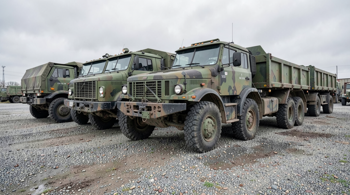
The range of surplus military vehicles adapted for commercial deployment spans light utility trucks through to heavy 8x8 cargo platforms. Cargo trucks represent the most commonly traded category. The MAN 18.225 4x4, for example, is documented with a gross weight of 16,500 kg, a maximum load of 16,000 kg, a MAN 6-cylinder D0836 engine displacing 6,871 cc, ISO container twist locks, and front and rear independent differential locks, with one recorded unit showing just 45,437 kilometres from new. 3 At the heavier end, the MAN 464 8x8 KAT A1 and the Foden 6x6 Tipper, powered by a Cummins 6-cylinder turbo producing 380 hp with an Eaton 12-speed manual gearbox and a GVW of 31,000 kg, represent platforms regularly cited in commercial export markets, with the Foden documented at just 80,095 kilometres. 4
The Mercedes-Benz Unimog family occupies a distinct position in this market. The U1300L drop-side 4x4 and the U1550L 4x4 box truck variants appear regularly in UK surplus catalogues, while the civilian-converted Unimog U5000 with portal axles, an 8-speed EPS transmission, eight crawler gears, a hydraulic winch rated at approximately 14 tonnes, and 14.00 R20 tubeless tyres represents the high-specification end of the Unimog spectrum in commercial expedition and logistics roles. 5 The Bedford TM 6x6 with an 18-tonne GVW and right-hand drive manual transmission, and the Iveco Eurotrakker 190E35 4x4 cargo truck, are additional models with documented commercial export histories into African and Middle Eastern markets.
Acquisition Channels and Documentation Requirements
Buyers in the United States access surplus military vehicles primarily through DLA Disposition Services, GSA Auctions, GovPlanet, IronPlanet, GovDeals, and Copart's government liquidation division. 2 Registration on these platforms is a prerequisite, and vehicles are typically sold via competitive online bidding with inspection periods prior to the auction close date. Physical inspection of drivetrain condition, chassis integrity, hydraulic systems, and electrical architecture is strongly recommended before bidding, as vehicles are frequently sold in as-received condition without mechanical warranties.
In the United Kingdom, any item that is military by design or contains component parts designed for military use requires a Standard Individual Export Licence (SIEL) before export from the country. 3 Buyers sourcing from continental European surplus dealers face equivalent export control frameworks, and OGIL (Open General Import Licence) terms apply to certain ex-MoD kit categories. Prospective commercial operators should verify the specific export classification of any vehicle before finalising a transaction, particularly for multi-axle and specialist platforms.
Commercial Applications Across Industry Sectors
The structural characteristics of surplus military trucks translate into a defined set of commercial use cases. Multi-axle platforms with differential locks and high ground clearance are widely used in construction, quarrying, off-road aggregate haulage, and rural infrastructure projects where paved road access is limited. Tanker variants, including documented examples such as the ex-Royal Navy DAF 50/160 4x2 9,000-litre AVGAS aviation fuel delivery tanker, find roles in fuel distribution, agricultural spraying, and water transport. 6 The Leyland DAF 4x4 5,000-litre tanker refueller is another example of a specialist platform with direct civilian utility.
Light utility vehicles such as the ex-British Army Land Rover 90, which carries features including a NATO hitch, military-grade roll-over hoop, and Goodyear G90 tyres, are frequently repurposed for estate management, rural farm work, and specialist film and photography support roles. The 1979 Chevrolet C10 Fleetside pickup, sourced from ex-US Forces stock with a 4.2-litre straight-six engine and 75,210 recorded miles, represents the lighter end of the spectrum for restoration-oriented commercial buyers. 7 The ZIL-131A 6x6 with KUNG box body, originating from Eastern European military stocks, is another platform documented as commercially serviceable, featuring a central tyre inflation system and a front-mounted winch. 8
Hidden Cost Factors and Refurbishment Realities
The headline auction price of a surplus military vehicle rarely reflects the full cost of bringing it into daily commercial operation. Refurbishment timelines of 30 to 180 days post-purchase are typical, during which expenses accumulate across hydraulic system overhauls, battery replacement, tyre replacement, brake inspections, fluid changes, filter replacement, and body modifications required for civilian payload configurations. 1 Suppliers offering prepared units, rather than as-received vehicles, generally provide servicing of all major components and a fresh coat of paint as part of the purchase price, though this is reflected in a higher asking price relative to as-is stock.
Electrical system compatibility is a recurring friction point. Many ex-military trucks operate on 24-volt electrical systems, which can create incompatibility with standard civilian accessories, lighting requirements, and diagnostic equipment used by commercial workshops. Parts availability varies substantially by platform: German MAN, Mercedes-Benz, and Iveco military variants generally benefit from stronger aftermarket support than Soviet-era platforms such as the ZIL-131A or Eastern Bloc Steyr models. Buyers should conduct structured supplier and parts availability assessments before committing to platforms with limited aftermarket visibility.
Regulatory Compliance and Road Legalisation
Converting a surplus military vehicle to commercial road use in any jurisdiction involves a structured compliance pathway. In the United States, the National Highway Traffic Safety Administration establishes regulations governing the conversion of military vehicles to civilian road-legal status, covering safety systems, lighting, braking standards, and emissions. 9 Military vehicle conversion specialists focus on removing classified equipment, upgrading braking and lighting to DOT standards, and verifying that gross vehicle weight ratings align with state-level registration requirements for commercial operators.
In the United Kingdom, vehicles released before 1 January 1977 may qualify for historic vehicle status, removing the annual MOT requirement and road tax obligation. An ex-British Army Land Rover 90 manufactured in 1986, for example, is documented as approaching MOT and tax exemption eligibility in December 2026, which reduces the ongoing regulatory burden and annual ownership costs considerably relative to a modern diesel platform subject to current emissions regulations. 10 Buyers in all markets should verify the applicable emissions zone restrictions, axle weight limits, and tachograph requirements before deploying surplus military platforms on commercial road routes.
Risk Considerations and Objective Assessment
The structural durability and payload capability of ex-military trucks are genuine and documented attributes. However, prospective commercial buyers must weigh several systemic risks. Odometer and hour-meter records on older surplus platforms may be incomplete or difficult to verify independently. Chassis modifications carried out during military service, including welded reinforcements, tow hitch adaptations, or body mounting changes, may not be documented in a way that satisfies commercial insurance underwriters. Engine emission classifications on older military diesel units, many of which predate Euro 3 or Euro 4 standards, may restrict operation in urban low-emission zones that are expanding across European and North American cities.
Fleet planners and procurement managers are advised to treat the acquisition of ex-military vehicles as a specialist procurement requiring independent mechanical inspection, legal review of export and import documentation, and a realistic total-cost-of-ownership projection. Platforms with high parts commonality with civilian fleet variants, such as the MAN or Mercedes-Benz military cargo trucks, generally present lower long-term operating risk than bespoke or obsolete military-only designs. Structured comparison of auction prices, refurbishment estimates, compliance costs, and parts availability across multiple vehicle types remains the most reliable analytical method for evaluating this category.
Sources
- Sinotruk Exp - Truck Military Auction Costs: Refit Risks Explained (sinotrukexp.com)
- Defense Logistics Agency - DLA Disposition Services (dla.mil)
- ExArmyUK - MAN 18.225 4x4 Cargo Truck (exarmyuk.com)
- Truckstop Africa - Foden 6x6 Tipper Ex-Military Truck (truckstopafrica.com)
- Unicat Expedition Vehicles - Second Hand EX45 HD Unimog U5000 (unicatexpeditionvehicles.com)
- ExArmyUK - Ex Royal Navy DAF 50/160 4x2 9,000 Litre AVGAS Tanker (exarmyuk.com)
- MilitaryMart - 1979 Chevrolet C10 Fleetside Pickup Ex-US Military Surplus (militarymart.co.uk)
- ForTankmen.com - ZIL 131A KUNG 1981 (fortankmen.com)
- National Highway Traffic Safety Administration - NHTSA (nhtsa.gov)
- John Brown 4x4 Ltd - Land Rover 90 Unwelded Chassis Ex-Military (johnbrown4x4.com)
Authored by 24Trendz team