Police impound offers market snapshot: chassis classification specifications and storage status availability
Police impound offers a market snapshot that extends well beyond a simple list of seized cars. Across North American jurisdictions, impound lots maintain active inventories sorted by chassis classification specifications and storage status availability, creating a data-rich environment that supports everything from fleet research to insurance benchmarking. Nationally, platforms aggregating this inventory now record more than 77,000 unclaimed vehicles listed annually, with an 82% sell-through rate compared to the 54% industry average, according to Autura Marketplace figures published in July 2026. 1
How Police Impound Inventory Is Generated and Classified
Vehicles enter municipal impound facilities through several legally distinct routes. Law enforcement agencies impound cars for unpaid parking violations above a defined threshold, DUI arrests, driving without insurance or a valid license, evidence holds in criminal investigations, and public safety hazards such as abandoned or unroadworthy vehicles on public roads. 2 Each pathway carries a different legal hold period and documentation requirement, which directly affects how the vehicle is classified in the facility's inventory system.
Once a vehicle arrives at an impound lot, intake personnel record chassis specifications including body type, VIN, odometer reading, and condition status. Storage status is then categorized into one of three primary designations: Held for Investigation, Abandoned or Unclaimed, or Auction-Ready. 3 These classifications are not static. A vehicle initially held as evidence can transition to Abandoned status once the investigation closes, and subsequently move to Auction-Ready once the legally mandated hold period of 30 to 90 days expires. 4
Chassis Classification Specifications Observed Across Major Lots
The Kansas City Police Tow Lot auction series provides a concrete illustration of chassis distribution within a large municipal impound operation. The November 2025 sale catalogued 401 vehicle lots broken down as follows: 214 cars, 114 SUVs, 41 trucks, 14 vans, 6 motorcycles and recreational vehicles, 1 boat, and 1 trailer. 5 The January 2026 sale recorded 305 lots including 163 cars, 69 SUVs, 33 trucks, 23 vans, and 7 motorcycles and recreational vehicles. 6 The March 2026 sale listed 198 vehicle lots covering 97 cars, 59 SUVs, 22 trucks, and 9 vans. 7
These figures confirm that sedans and passenger cars consistently represent the largest chassis category, typically accounting for roughly 50% of any given lot, while SUVs form the second-largest group at approximately 28 to 30%. Trucks, vans, and specialty chassis types such as motorcycles, trailers, and commercial vehicles fill the remaining inventory. This distribution mirrors broader used-vehicle market patterns and reflects which chassis types are most commonly operated by the general public. Chassis classification in impound systems often references the ACRISS four-character vehicle code structure, where the second character defines the physical body type ranging from 2/3-door configurations to wagons, SUVs, convertibles, and commercial vans. 8
Storage Status Availability and Its Effect on Market Timing
Storage status availability is a time-sensitive variable that governs when a vehicle becomes accessible to the public auction market. Regulatory agencies, including state Departments of Motor Vehicles, mandate specific minimum hold periods before an impounded vehicle can transition to public auction status. 9 The average hold period across most U.S. jurisdictions falls between 30 and 90 days. 4 When owners fail to reclaim vehicles within this window, the scale of attrition is significant: approximately 20% of all impounded vehicles are never reclaimed, representing roughly 200,000 units annually entering the auction pipeline. 10
Storage status also has direct cost implications that accelerate abandonment. Daily storage fees typically range from $25 to $75 depending on jurisdiction and facility type. 11 At the Kansas City Tow Lot specifically, a $30 per day late-pickup fee applies to winning bidders who fail to remove vehicles by the Saturday following the sale. 7 For original vehicle owners, the total cost to reclaim a car from impound, including towing, administrative processing, and accrued storage, commonly falls between $500 and $1,500, a financial barrier that contributes to the volume of vehicles transitioning to Auction-Ready status. 10
Auction Structure, Fees, and Operational Standards
Municipal impound auctions operate under standardized procedural frameworks that define bidder registration requirements, payment timelines, and buyer fees. At the Kansas City Tow Lot, a $300 deposit is required to register for participation, with the deposit automatically applied to the winning bid or refunded within 5 to 10 days for non-winning participants. 7 All sales are subject to a $25 per-lot administrative fee plus a 10% buyer's premium. Payment is due the day after auction close, accepted as cash by 5 p.m. or wire transfer by 2 p.m., with no partial or late payments accepted and non-payment resulting in a permanent auction ban. 12
All vehicles are sold on an as-is, where-is basis with no warranties expressed or implied. In most cases, buyers cannot determine whether a vehicle runs until after purchase, and most lots do not include keys. 12 Secure storage facility contracts, such as the California Highway Patrol's Evidence Impound Tow and Storage Services solicitation under IFB #26C390002, which carries an estimated contract value of $400,000 for the term from March 2027 to February 2030, illustrate the institutional complexity behind maintaining impound storage infrastructure. 13
Risks, Title Status, and VIN History Considerations
Purchasing vehicles from police impound carries specific risks that distinguish this segment from conventional used-car markets. Buyers typically do not receive a standard vehicle title from the auction operator. Instead, municipal impound lots mail a title processing document after the sale, and the buyer assumes responsibility for completing the title transfer independently. 6 This process introduces the possibility of encountering unresolved liens, branded titles, or chain-of-custody gaps that complicate registration.
Running a VIN through a vehicle history report that references National Motor Vehicle Title Information System (NMVTIS) data before bidding is considered a necessary precaution. 14 An impound record alone does not disqualify a vehicle, but it can indicate hidden title problems, unresolved financial liens, or mechanical deterioration resulting from extended lot storage. Condition in the impound market varies widely, from fully drivable units to severely damaged or inoperable chassis. 15 Insurance salvage auction platforms such as Copart and IAA aggregate some police-seized inventory alongside insurance total-loss vehicles, providing chassis damage assessments, loss type classifications, and odometer readings as additional data points for researchers and buyers. 16
Infrastructure Capacity and Lot Utilization Metrics
Impound lot operational performance is tracked through several key metrics relevant to understanding storage status availability at any given time. Industry benchmarks target a lot utilization rate of 85% or higher, measured daily as the ratio of vehicles stored to total available spaces. The average daily storage fee metric is tracked weekly to ensure fee schedule compliance, while average days to recovery, targeting under seven days from intake to release, governs throughput capacity. 17 Baseline fixed monthly operating costs for a vehicle impound lot are estimated at approximately $19,500 excluding rent and wages. 17
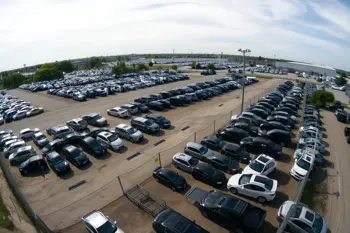
Physical capacity constraints can force operational interventions. In Edmonton, Canada, the city and police service collaborated in July 2026 to add 150 temporary storage spaces to the municipal impound lot to address overflow conditions. 18 The Garland, Texas Police Impound facility, located at 3423 S. Shiloh Rd., operates on an 11-acre property with a stated capacity of up to 3,000 vehicles, managed by dedicated property and evidence staff. 19 These capacity realities directly influence how quickly vehicles cycle through storage status classifications and become available for public auction or disposition.
Sources
- Autura / EIN Presswire - autura-rebuilds-the-marketplace-that-auctions-77-000-unclaimed-vehicles-a-year (einpresswire.com, July 2026)
- Wikipedia - Vehicle impoundment (en.wikipedia.org)
- ShunAuto - Understanding Police Impound Cars: What They Are And How They Work (shunauto.com)
- RevvBid - Ultimate Guide to Buying Impounded Vehicles (revvbid.com)
- OAI Auctions - Kansas City Police Auction November 18 2025 (bids.oaikc.com)
- OAI Auctions - Kansas City Police Auction January 20 2026 (bids.oaikc.com)
- OAI Auctions - Kansas City Police Auction March 03 2026 (bids.oaikc.com)
- ACRISS - Car Classification System (acriss.org)
- CarCheckerVIN - Impound History by VIN: What You Should Know Before Buying a Former Tow Yard Car (carcheckervin.com, July 2026)
- Five Star Towing / 247okctowing.com - What Happens in an Impound (247okctowing.com)
- General industry research - storage fee range data
- OAI Auctions / Woolsey Auction - Kansas City Police Tow Lot Auction Terms and Conditions (auctions.oaikc.com)
- CLEATUS - CHP Dublin Area Office Evidence Impound Tow and Storage Services IFB #26C390002 (cleat.ai)
- CarCheckerVIN Editorial Team - Impound Vehicle VIN History (carcheckervin.com)
- ShunAuto - Police Impound Vehicle Characteristics Table (shunauto.com)
- Rebrowser / IAAI Dataset - Auction Listings (rebrowser.net)
- Financial Models Lab - 7 KPIs to Hit Vehicle Impound Lot Breakeven by March 2027 (financialmodelslab.com)
- Edmonton CityNews - Edmonton Police City working to make space at Impound Lot with 150 temporary spaces (edmonton.citynews.ca, July 2026)
- what.it.is - Unveiling the Garland Police Impound (what.it.is)
Authored by 24Trendz team