Top sources for purchasing decommissioned military power generators: An evidence-based market guide
Top sources for purchasing decommissioned military power generators fall into several distinct categories: federal disposition programs, government surplus marketplaces, industrial auction platforms, and specialist equipment dealers. The central difference is whether a unit is sold as government surplus, inspected used equipment, or part of a larger decommissioning project.
1. Federal government disposition channels
GSA Auctions is the U.S. General Services Administration’s online marketplace for surplus federal personal property offered to the public. It is therefore a primary source category for equipment released from federal ownership, although an individual listing must be reviewed to determine whether a generator is present, what agency supplied it, and what condition information accompanies the asset. 1
DLA Disposition Services manages the reutilization, transfer, donation, sale, and disposal of excess Department of Defense property. That role makes it especially relevant to military-origin equipment, but availability and purchaser eligibility can vary according to the disposition process and listing terms. A generator described as excess property should not automatically be treated as tested or ready for service. 2
2. Government and military surplus marketplaces
GovPlanet specializes in online sales of used government and military surplus equipment and commonly presents generators alongside utility equipment and other tactical assets. The platform can provide access to equipment that originated in government inventories, but the buyer still needs to distinguish military provenance from actual operating condition, hours, missing accessories, and removal obligations. 3
GovDeals, Public Surplus, Municibid, and AllSurplus broaden the search beyond federal military property. GovDeals serves government agencies and other public-sector sellers, Public Surplus represents government, school, and institutional consignors, Municibid focuses on municipal and public-agency auctions, and AllSurplus, operated by Liquidity Services, handles government and commercial surplus assets. 5679
3. Industrial auction and equipment platforms
IronPlanet conducts online auctions for used heavy equipment and government surplus, with inspection reports available for applicable listings. Those reports can be useful when they include model identification, operating observations, or test information, but inspection coverage is listing-specific. A report should be read as evidence about the particular unit rather than as a general guarantee for every generator on the platform. 4
BidSpotter lists industrial-equipment auctions conducted by participating auctioneers, while Proxibid connects buyers with independent auction companies offering equipment and other assets. These platforms can expose buyers to regional industrial liquidations and timed or live auctions, but seller terms, buyer qualifications, inspection access, payment procedures, and transport arrangements may differ substantially from one event to another. 810
4. Specialist used-power-equipment dealers
Specialized dealers represent a different purchasing channel from an auction. Power Generation Enterprises states that its inventory includes diesel and natural-gas generator sets from Caterpillar, Cummins, MTU or Detroit Diesel, Kohler, Doosan, Waukesha, Volvo, Perkins, John Deere, and Generac, spanning 20 kW portable units to power plants above 3,500 kW. 15
The same dealer states that units undergo inspection and load-bank testing at its Santa Clarita, California facility, with specification sheets, load-test reports, and maintenance documentation supplied when available. MacAllister Used Power Systems describes low-hour diesel and natural-gas equipment, North American and international shipping, financing plans, and a certified-used process involving an 80-point inspection, repair, and testing. These are vendor-reported practices that should be confirmed for the specific unit. 1517
5. Decommissioning and asset-recovery specialists
USA Decom describes a full-service model that combines generator purchasing with electrical disconnection, fuel removal, rigging, transportation, and other removal activities. This channel is relevant when a generator remains installed in a data center, hospital, manufacturing site, energy facility, or commercial building and cannot be treated as a simple portable-equipment transaction. 16
Power Generation Enterprises reports handling single units and complete fleet liquidations, including equipment from data centers, hospitals, oil and gas operations, and manufacturing plants. Its asset-recovery material states that industrial generators can lose 15% to 30% of resale value for each year they sit idle after decommissioning, while a well-maintained Caterpillar 3516 DITA rated at 1,850 kW may recover 40% to 55% of original acquisition cost within the first two years and 25% to 35% after three years. These figures are company-reported market observations, not universal valuations. 13
6. Technical and compliance checks before purchase
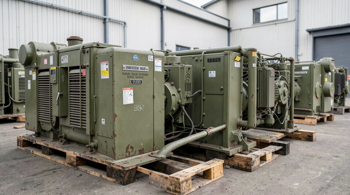
Military surplus status does not establish that a generator is unused, operational, complete, or compatible with a planned electrical system. Research material distinguishes surplus from ordinary used equipment because some surplus units may be new, held in inventory, manufactured in excess, or purchased by a government entity and never used. Other units are lightly used or decommissioned, making hours, service history, storage conditions, and testing essential facts. 12
Documentation should be matched to the intended installation. Relevant records can include the nameplate, model and kW rating, engine hours, maintenance history, load-bank results, control-panel condition, fuel-system details, switchgear compatibility, ownership history, and removal scope. For larger lots, PGE notes that package value also depends on unit consistency and associated switchgear. Logistics can include rigging, transport, fuel handling, electrical isolation, and site access, so the apparent auction price is only one component of the acquisition decision. 191416
How the sources compare
| Source category | Typical role | Main friction point |
|---|---|---|
| Federal disposition | Federal and defense excess property | Eligibility, listing terms, and condition uncertainty |
| Public surplus marketplaces | Government, school, municipal, and commercial consignments | Variable seller documentation and inspection access |
| Industrial auctions | Timed or live sales of equipment and liquidations | Event-specific fees, transport, and testing limitations |
| Specialist dealers | Inspected used generator inventory | Unit-specific verification and commercial terms |
| Decommissioning specialists | Installed equipment purchase and removal | Rigging, disconnection, fuel removal, and scheduling |
The most suitable source depends on provenance, size, condition, documentation, and whether the generator is already removed. Federal and defense channels are closest to original military disposition, auction platforms provide varied public access, dealers generally organize inventory around technical specifications, and decommissioning firms address equipment that remains embedded in a facility. No category eliminates the need for independent verification.
For multi-unit requirements, a lot sale may involve generators, paralleling equipment, and switchgear together. PGE describes package transactions involving retired power plants, data-center generator yards, and groups of two or more surplus units, with valuation influenced by consistency across the fleet. The practical comparison is therefore not only source versus source, but also complete system versus isolated generator, documented equipment versus uncertain equipment, and removed equipment versus equipment requiring site work. 19
Sources
- U.S. General Services Administration, GSA Auctions
- Defense Logistics Agency, Disposition Services
- GovPlanet
- IronPlanet
- GovDeals
- Public Surplus
- Municibid
- BidSpotter
- AllSurplus
- Proxibid
- Mosquera, Army Surplus Diesel Generators
- Central States Diesel Generators, Benefits of Buying Surplus Military Generators
- Power Generation Enterprises, Asset Recovery for Industrial Power Equipment
- Power Generation Enterprises, Used Generator Buyers and Selling Channels
- Power Generation Enterprises, About Us
- USA Decom, Sell and Remove Industrial Generators Nationwide
- MacAllister Used Power Systems
- USA Decom, Used Generator Buyers in Colorado Springs
- Power Generation Enterprises, Selling Multiple Generators or a Power Plant Lot
Authored by 24Trendz team