Perimeter Laser Alarm Systems on sale: A Market Analysis and Buyer's Reference Guide
Consumer and commercial interest in perimeter laser alarm systems on sale has intensified alongside a broader expansion in physical security spending. The global laser perimeter security systems market reached USD 5.2 billion in 2024, with projections pointing toward approximately USD 10.8 billion by 2033 at a compound annual growth rate of 8.6%. 1 For property owners, facilities managers, and security integrators comparing products across this category, understanding what drives pricing, performance variation, and installation complexity is essential before any purchasing decision is made.
How Perimeter Laser Alarm Systems Actually Work
Perimeter laser alarm systems operate on an active detection principle. A laser transmitter emits a focused beam at a specific wavelength, typically 650nm, 660nm, 808nm, or 980nm depending on the model, toward a corresponding receiver unit mounted at a defined distance. 2 When an intruder interrupts the beam path, the receiver output transitions from a high-level signal to a low-level signal, triggering an alarm relay. Detection time in professional-grade units is measured in milliseconds, with configurable response windows ranging from 10ms to 100ms in systems such as the BTD-series laser beam detectors. 3
Multi-beam configurations reduce false alarm rates significantly compared to single-beam designs. A four-beam hardwired infrared detector, for example, activates an alarm only when all four beams are simultaneously blocked, with adjustable interruption timing between 35 and 700 milliseconds. 4 Similarly, twin-beam sensor systems like the Seco-Larm E-960 series require simultaneous breaking of two beams before triggering output, with selectable time intervals that help screen out birds and falling debris. 5
Detection Range and Coverage: What the Specifications Mean
Detection range is the most commonly compared specification in this product category, but published figures require careful interpretation. Outdoor maximum range consistently falls below indoor maximum range for the same hardware. The Seco-Larm E-960-D290Q achieves a 290ft (88m) outdoor range and a 590ft (180m) indoor range under optimal conditions. 5 Industrial-grade outdoor sensors from manufacturers such as DAIDISIKE reach up to 500 meters, housed in 304 stainless steel with an IP67 waterproof rating and Class 1 laser sources. 6 More entry-level systems may target 100m outdoor ranges with IP55 or IP65 protection ratings.
The following table summarizes commonly referenced outdoor range tiers and their associated protection ratings across product documentation reviewed:
| Range Tier | Typical Outdoor Coverage | IP Rating (Common) | Typical Application |
|---|---|---|---|
| Short Range | Up to 100m | IP55 to IP65 | Residential gates, small property fencing |
| Medium Range | 100m to 300m | IP65 to IP66 | Commercial yards, warehouses, solar farms |
| Long Range | 300m to 500m | IP66 to IP67 | Substations, airports, military perimeters |
Signal Strength, Alignment, and Common Installation Challenges
Proper beam alignment is the most critical factor determining whether a perimeter laser alarm system performs reliably after installation. Security engineers recommend achieving receiver signal strength of 70% or above for outdoor projects, not merely the 50% threshold that qualifies as a basic minimum. 7 A signal in the 50% range may sustain normal operation indoors, but outdoor deployments involving wind, vibration, dust, and changing weather demand the higher threshold to prevent both missed alarms and nuisance triggers. Below 50% signal strength, re-alignment is mandatory before the system is considered operational. 7
Common commissioning failures documented in installation guides include weak mechanical fixing allowing post vibration, incorrect occlusion mode settings, cable connection faults, and incomplete end-to-end testing. Optical axis adjustment ranges typically span plus or minus 30 degrees horizontally and vertically in professional beam detectors, but even small angular deviations at 300-meter distances translate into significant positional drift at the receiver. Solar-powered wireless variants like the JHW series simplify wiring but require one full day of sunlight to maintain up to 30 days of standby charge in rainy conditions, a factor that must be accounted for in year-round deployment planning. 8
Market Landscape: Key Segments and Regional Dynamics
The perimeter laser tripwire systems sub-market was valued at USD 1.2 billion in 2024 and is forecast to reach USD 3.5 billion by 2033, reflecting a CAGR of 12.7%. 9 North America currently holds approximately 38% of total global revenue in this segment, driven by military and defense procurement alongside commercial and critical infrastructure investment. 9 Asia Pacific has emerged as the dominant region in the broader laser perimeter security systems market, accounting for 35.2% of revenue share as of 2025, while critical infrastructure applications represent the largest single application vertical at 28.5% of the total market. 10
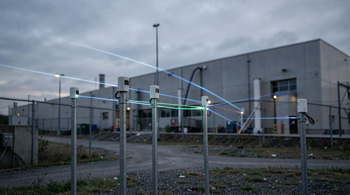
Honeywell International leads the competitive landscape according to market research covering 2025 to 2034, though the category includes specialist manufacturers, regional suppliers, and integrators offering proprietary analytics layers. 10 The integration of artificial intelligence, IoT connectivity, and 3D LiDAR technology is accelerating differentiation among enterprise-grade systems. Southwest Microwave's INTREPID LiDAR platform, for instance, uses laser-based spatial detection to create precise detection zones and track movement in real time, specifically engineered to reduce nuisance alarms caused by wildlife or environmental conditions at critical infrastructure sites. 11
Pricing Context and Product Tiers Across the Category
Published pricing across the perimeter laser alarm category spans several orders of magnitude depending on system type, range capability, and intended deployment environment. Entry-level infrared beam twin sensor pairs intended for residential or light commercial use have appeared at reference price points around USD 221 for 190ft outdoor range and approximately USD 267 for 290ft outdoor range configurations. 5 Mid-range hardwired four-beam detectors covering 100m outdoor ranges have been documented at approximately USD 217. 4 Enterprise analytics licensing for camera-based perimeter AI platforms has been listed at over GBP 4,000 for a single site license in the UK market. 12 Pricing on any given product reflects beam count, build material, IP rating, detection range, wireless capability, and whether the unit includes a host panel or integrates into a third-party control system.
Solar-powered wireless variants occupy a distinct segment, offering infrastructure-free installation at the cost of charging dependency. These units are commonly deployed across unmanned orchards, fish ponds, construction sites, and border posts where wiring is impractical. 8 Buyers should verify whether any unit purchased functions as a standalone alarm or requires pairing with a separate host system, as some solar beam detectors cannot operate independently and will only relay signals to a compatible alarm panel.
Performance Limitations, Risks, and Regulatory Considerations
Environmental interference is the primary operational risk in outdoor perimeter laser systems. Rain, fog, dust accumulation on optical lenses, and extreme temperature swings all degrade signal quality over time. Professional standards call for optical axis adjustment, lens cleaning schedules, and periodic signal strength verification as part of any ongoing maintenance program. Systems without adequate IP protection ratings are not suitable for installations in regions experiencing heavy rainfall, coastal humidity, or sustained sub-zero temperatures. Operating temperature ranges vary by product: the BTD-series laser detectors specify a range of -55 degrees Celsius to 70 degrees Celsius, while hardwired four-beam detectors are commonly rated from -25 degrees Celsius to +55 degrees Celsius. 3
False alarm management also carries real cost implications for commercial and government operators. Traditional video and infrared perimeter systems at airports are documented as frequently generating false alarms from wildlife or shifting weather, creating personnel fatigue and diverting attention from genuine threat events. 13 Multi-beam designs, time-interval filtering, and LiDAR-based spatial classification each address this problem at progressively higher system cost. Regulatory requirements for laser classification must also be observed: Class 1 laser sources are internationally recognized as safe under normal use conditions, while higher-power configurations require compliance with national laser safety standards and may necessitate restricted-area signage and trained operator oversight.
Sources
- Growth Market Reports - Laser Perimeter Security Systems Market Research Report 2033 (growthmarketreports.com)
- Security Zone Info - Perimeter Laser Tripwire Systems Explained (security-zone.info)
- UIMI Alarm - Laser Beam Intrusion Detection BTD-Series Specification Table (uimialarm.com)
- Mitech Store - 4x Beam Hardwired IR Motion Detector ALE-PIRB Product Listing (mitechstore.com)
- Active123 - Seco-Larm E-960-D290Q and E-960-D190Q Photoelectric Beam Twin Sensors (active123.com)
- DAIDISIKE Optoelectronic - DDSK-J Series Outdoor Laser Beam Sensor 500m Product Overview (daidisensor.com)
- Gato Security - Laser Beam Detector Alignment and Debugging Guide (gato-security.com)
- DAIDISIKE Optoelectronic - JHW Solar Wireless Infrared Beam Detector Product Overview (daidisensor.com)
- Research Intelo - Perimeter Laser Tripwire Systems Market Research Report 2033 (researchintelo.com)
- Market Intelo - Laser Perimeter Security Systems Market Research Report 2034 (marketintelo.com)
- Perimeter Systems Australia / LinkedIn - Southwest Microwave INTREPID LiDAR for Critical Infrastructure Security (linkedin.com)
- Spark Security Store UK - AXIS Perimeter Defender Product Listing (sparksecuritystore.co.uk)
- Quanergy - 3D LiDAR Sets New Benchmarks in Perimeter Intrusion Detection (quanergy.com)
Authored by 24Trendz team