12-day river cruise to India: An objective itinerary and planning analysis
12-day river cruise to India itineraries generally combine cultural touring on land with several nights on the Ganges or Hooghly River. Current examples range from Kolkata and the Sundarbans to Delhi, Agra, Jaipur, and remote Bengal villages, so the phrase can describe materially different journeys rather than one standard route. 1
What a 12-day itinerary can include
One documented 12-day Hooghly and Sundarbans programme is priced at £4,395 excluding flights, with a stated 5% government tax applied to cabin prices. The published inclusions are all meals, excursions, cultural performances, educational talks, cooking classes, and onboard facilities. Vegetarian and vegan dietary requirements can be accommodated, while the final cost depends on cabin selection and departure date. 1
A different format uses the river cruise as one part of a longer land-and-water circuit. The Golden Triangle model begins in Delhi, continues to Agra and Jaipur, and then moves toward the Ganges before concluding in Kolkata. One published itinerary describes five hotel nights followed by a seven-night cruise, making the overall journey 12 nights rather than 12 continuous nights aboard a vessel. 2
Golden Triangle and Ganges routing
Golden Triangle itineraries focus on Delhi, Agra, and Jaipur before reaching the river. Reported highlights include Humayun’s Tomb and Raj Ghat in Delhi, the Taj Mahal at sunrise and sunset, Jaipur’s palaces and forts, and river visits to Kalna, Matiari, Murshidabad, Baranagar, Khusbagh, Mayapur, and Chandannagar. These routes emphasize historical and religious heritage alongside observation of village life along the Ganges. 3
The land segment creates an important distinction from a conventional embarkation-to-disembarkation cruise. A published 12-night example lists two nights in New Delhi, one night in Agra, two nights in Jaipur, and seven nights aboard Ganges Voyager II. Flights and transfers are not necessarily included in every distribution of the itinerary, and some packages describe air credits or hotel substitutions, so inclusions require careful comparison. 4
Hooghly and Bengal river experiences
The Hooghly route offers a different geographic emphasis from the Golden Triangle. Published descriptions identify Kolkata, Bandel, Kalna, Chandannagar, Serampore, Murshidabad, and villages such as Matiari and Baranagar. Chandannagar retains traces of its former French settlement, while Kalna is associated with terracotta temples and the Naba Kailash Mandir. Murshidabad adds the Hazarduari Palace and wider links to Bengal’s political history. 5
Small vessels are particularly relevant on Bengal waterways because shallow-draft boats can reach stretches unavailable to larger ships. The ABN Rajmahal, described in one 12-day itinerary, is 50 metres long, carries up to 40 passengers, and has 22 cabins, including twin, double, and single arrangements. Its facilities include a saloon, bar, dining room, shaded sundeck, compact spa, air conditioning, and French balconies. 5
Ships, accommodation, and onboard arrangements
Indian river cruises commonly use smaller ships than major European river programmes. The research material places typical vessel capacity between 20 and 50 passengers, a scale that supports access to narrower waterways but can also mean fewer public facilities and less redundancy if operational disruption occurs. Ganges Voyager II is described as an elegant ship with riverview staterooms, while the Charaidew II accommodates 34 guests on Brahmaputra expeditions. 3
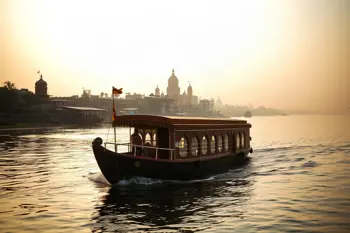
Luxury positioning does not make every itinerary identical. Some programmes specify all meals, guided shore excursions, lectures, performances, wellness activities, and cultural demonstrations, while others separate flights, transfers, taxes, or hotel arrangements from the core cruise cost. A consumer comparison should therefore distinguish cruise nights from hotel nights, identify the river section being navigated, and verify whether gratuities, drinks, and excursions are included. 4
Seasonality, wildlife, and environmental limits
The primary cruising season for Indian rivers is generally described as September or October through April, avoiding the heaviest monsoon rainfall and the most intense summer heat. River conditions, local access, and excursion schedules can still vary, meaning an itinerary should not be treated as a fixed sequence of guaranteed shore experiences. The seasonal window is a planning framework, not a promise of uniform weather or navigation. 7
Brahmaputra journeys present a distinct wildlife focus from Ganges and Hooghly cultural routes. A documented expedition combines Kolkata with Assam, Kaziranga National Park, Majuli Island, and riverside communities, with searches for Asian one-horned rhinoceroses, Asian elephants, Royal Bengal tigers, wild water buffalo, hornbills, and Gangetic dolphins. Wildlife sightings remain observational outcomes rather than assured inclusions. 6
Documentation, costs, and practical risks
Travelers typically require an Indian e-Tourist Visa, and the supplied travel guidance recommends obtaining the necessary documentation well before departure. Eligibility, passport validity, entry conditions, and nationality-specific rules can change, so visa information should be checked against current official guidance rather than relying solely on an itinerary page. This is a regulatory requirement separate from cruise reservations, hotel arrangements, and airline schedules. 7
Published figures illustrate a wide cost range rather than a market standard. The Hooghly and Sundarbans cruise lists £4,395 excluding flights, while another 12-night Golden Triangle and Ganges example lists a suite from $13,199 per person. A separate 13-day programme is shown from £7,008 per adult, and one 13-day Uniworld distribution from £6,399 per person. Cabin category, taxes, dates, hotels, transfers, and inclusions materially affect comparisons. 2
How to evaluate an itinerary objectively
The first evaluation question is whether the advertised duration means 12 days, 12 nights, or a 12-night package containing both hotels and cruise nights. The second is the route: Kolkata to Bengal destinations, a Golden Triangle combination, or an Assam and Brahmaputra expedition. A useful comparison records embarkation point, disembarkation point, number of sailing nights, land transport, hotel standards, excursion scope, and whether flights are excluded. 8
Operational friction should also be considered. River levels, monsoon conditions, road transfers, local access, visa processing, and the limited capacity of small ships can affect schedules and comfort. A 12-day cruise may offer a concentrated view of India’s historical, spiritual, urban, and rural landscapes, but it is not a substitute for independent regional travel. The most reliable assessment comes from matching the route’s physical demands and inclusions to the traveler’s requirements. 1
Sources
- Responsible Travel, Hooghly and Sundarbans river cruise in India
- Best Value Tours, Authentic Style River Cruise of India’s Golden Triangle
- Cruiseabout, India’s Golden Triangle and the Sacred Ganges
- ROL Cruise, India’s Golden Triangle and the Sacred Ganges
- Peregrine Travel Centre, Ganges Maximum River Cruise
- Lindblad Expeditions, India Expedition: Kolkata, Kaziranga and the Brahmaputra River
- Foreign, Commonwealth & Development Office, India entry requirements and travel guidance
- World of Cruising, Delhi to Kolkata aboard RV Bengal Ganga
Authored by 24Trendz team