14-day Asia cruise to Japan: An itinerary and planning analysis
A 14-day Asia cruise to Japan can combine major Japanese destinations with ports in Taiwan, South Korea, China, Hong Kong, Vietnam or Singapore, depending on the ship and sailing direction. The documented examples below show how a two-week voyage may operate as a Japan-intensive circuit, a Hong Kong-to-Tokyo route, or a longer Singapore-to-Tokyo regional crossing.
What a 14-day itinerary usually includes
In cruise terminology, a 14-day sailing commonly represents 14 nights and 15 calendar days, with embarkation on day one and disembarkation on day 15. A Westerdam Circle Japan itinerary, for example, departs Tokyo, visits Hiroshima, Toyama, Hakodate, Aomori, Tsuruga, Sakaiminato, Busan, Osaka, Kochi and Sakata, then returns to Tokyo.
Other routes use the two-week duration to cover a wider geographic arc. Seabourn Encore has a documented sailing from Hong Kong to Tokyo calling at Japanese ports including Aburatsu, Shimizu, Naha, Shingu, Osaka, Kochi and Ishigaki Island, while also visiting Tainan, Keelung and Taichung in Taiwan. The published schedule includes sea time and a route map identified as having 12 ports 1.
Representative route patterns
| Route type | Documented examples | Geographic emphasis |
|---|---|---|
| Circle Japan | Tokyo return on Westerdam | Japanese coastal ports with Busan |
| Japan and Taiwan | Hong Kong to Tokyo on Seabourn Encore | Japan, Taiwan and selected sea days |
| China and Japan | Hong Kong to Tokyo on Noordam | Japan, Shanghai and an Osaka overnight |
| Regional Asia | Singapore to Tokyo on Diamond Princess | Singapore, Vietnam, Hong Kong, Taiwan and Japan |
The Noordam route demonstrates another structure: Hong Kong, Shimizu, Kagoshima, Nagasaki, Osaka, Shanghai, Kochi and Fukuoka, ending in Tokyo. The published itinerary includes sea days between some port calls and identifies Shanghai as a central regional stop, making this format different from a Japan-only circuit 6.
The Princess Diamond Princess itinerary begins in Singapore and reaches Tokyo after calls associated with Vietnam, Hong Kong, Taiwan and Japan. Listed destinations include Ho Chi Minh City, Hue and Da Nang, Okinawa, Keelung, Ishigaki Island, Kagoshima and Tokyo, illustrating how a 14-day sailing can function as a multi-country journey rather than a concentrated Japanese coastal voyage 3.
Japanese ports and shore-day focus
Port selection determines the type of Japan experience available. Tokyo provides a major urban gateway, Osaka connects with the Kyoto area, Hiroshima offers historical and cultural significance, and Hakodate, Aomori, Toyama, Kochi, Kagoshima and Nagasaki create a broader coastal profile. A Japan-intensive Azamara itinerary is described as visiting Tokyo, Sakata, Toyama and Maizuru, with additional stops including Hakodate and Busan in the itinerary overview 5.
Port names do not always indicate that the ship docks in the city most associated with the destination. Kyoto may be represented by Kobe, while Seoul may be represented by Incheon, and Taipei may be represented by Keelung. Oceania's documented Tokyo round trip lists Kyoto as Kobe and Seoul as Incheon, alongside Nagoya, Beppu, Kitakyushu, Busan, Jeju, Shanghai, Kagoshima, Kochi and Shimizu 7.
Ships and onboard differences
Representative ships vary substantially in scale and operating style. Diamond Princess is listed with 2,670 passengers and 1,100 crew, while Westerdam is listed with 1,916 passengers and 800 crew. Seabourn Encore is associated with smaller, destination-focused exploration itineraries, although the supplied route record does not provide a passenger count. These differences can affect the atmosphere, shore-operation rhythm and range of onboard facilities.
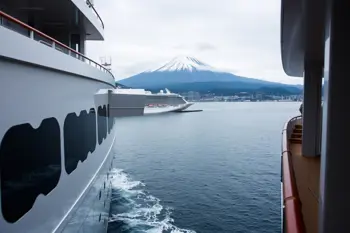
Azamara's itinerary description highlights late nights, overnight stays and shore-based cultural events as features associated with the line's destination-focused approach. By contrast, the documented Holland America routes emphasize a structured sequence of port calls and sea days, including an Osaka overnight on the Noordam China and Japan itinerary. These descriptions are useful comparisons, but individual sailing schedules remain subject to change 4.
Entry requirements for a multi-country voyage
Australian passport holders generally can visit Japan for short-term tourism without obtaining a visa in advance, subject to the applicable period of stay and current conditions published by Japan's Ministry of Foreign Affairs 10. The Australian Government's Smartraveller advice should also be checked for passport validity, entry conditions, safety information and any requirements affecting the complete cruise itinerary 11.
A cruise calling at several countries creates separate compliance obligations. Taiwan, Hong Kong and South Korea each publish their own visitor or transit rules, and South Korea's K-ETA requirements can depend on nationality and travel date 14 15 16. Japan's Visit Japan Web service allows eligible travellers to submit immigration and customs-related arrival information online before reaching Japan, but it does not replace checking the rules for other ports 13.
Costs, timing and operational risks
Published cruise fares should be treated as a starting category rather than the complete travel cost. Airfare, gratuities, shore excursions, drinks packages, specialty dining, travel insurance and some port taxes may be excluded. One documented Oceania sailing lists fares from €5,419 per guest, while a Global Journeys Princess listing gives a price from A$2,711 per person, demonstrating that advertised amounts differ by line, ship, cabin, date and inclusions 7 3.
Seasonality is a major planning variable. Japan itineraries are particularly associated with spring blossom and autumn foliage periods, but weather, sea conditions and port restrictions can alter the published sequence or prevent a call. Travellers should also account for international flights, possible pre-cruise accommodation, transfers between airports and terminals, passport documentation, and the practical risk that a delayed flight may conflict with embarkation.
Official destination information from Japan's tourism organisation covers transport, seasons and visitor planning, while major cruise operators describe Asia itineraries that include Japan and neighbouring destinations 12 17 18 19. The most material friction points are therefore not limited to choosing ports: they include coordinating visas or electronic authorisations, interpreting gateway-city labels, allowing sufficient transfer time and verifying the final schedule with the relevant operator.
Sources
- Cruises.To, Seabourn Encore, 14-Day Exploring Taiwan & Japan Charming Harbors
- Cruises.To, Holland America Line Westerdam, 14-DAY CIRCLE JAPAN
- Global Journeys, Southeast Asia & Japan, Princess Diamond Princess
- Cruises.To, Seabourn Encore, 14-Day Exploration Of Hokkaido & Korea
- World of Cruising, Japan Intensive Cruise on Azamara Pursuit
- Cruises.To, Holland America Line Noordam, 14-Day China & Japan Discovery
- Oceania Cruises, Autumn in Asia, Tokyo to Tokyo
- World of Cruising, Hong Kong to Tokyo on Noordam
- Global Journeys, Southeast Asia & Japan, Princess Diamond Princess
- Japan Ministry of Foreign Affairs, Visa Exemptions
- Australian Government Smartraveller, Japan Advice
- Japan National Tourism Organization, Australia Website
- Visit Japan Web
- Taiwan Bureau of Consular Affairs
- Hong Kong Immigration Department
- Korea Electronic Travel Authorization
- Norwegian Cruise Line, Asia Cruises
- Princess Cruises, Asia Cruises
- Royal Caribbean, Asia Itinerary Search
Authored by 24Trendz team