10 Days Tour to Croatia: A Complete Route-by-Route Planning Guide
Planning a 10 days tour to Croatia is widely regarded by travel researchers and itinerary specialists as the optimal duration for covering the country's defining highlights without constant rushing. Ten days allows travelers to experience the full Dalmatian spine, from the cascading waterfalls of Plitvice Lakes and the Roman ruins of Split to island-hopping across Hvar and Korcula, finishing inside the medieval walls of Dubrovnik. Operators including G Adventures, Explore!, Katarina Line, EuropaAdventure, and Indogusto LLC have designed structured programs around this exact timeframe for years. 1
The Classic Route Structure: Zagreb to Dubrovnik
The backbone of any 10-day Croatia itinerary runs north to south, with Zagreb or Plitvice Lakes as the starting point, Split and the Dalmatian islands forming the mid-section, and Dubrovnik anchoring the final days. 2 This directional flow works because the entire coast runs along a single road and a connected ferry network, meaning travelers are always moving forward rather than retracing ground. A widely recommended shape allocates roughly one night near Plitvice, two to three nights in Split, two to three nights across the islands, and two nights in Dubrovnik. 3
Some operators structure the tour in reverse, beginning in Dubrovnik and ending in Zagreb. This is equally viable and may suit travelers whose flight connections into Dubrovnik Airport (DBV) are more practical. Open-jaw ticketing, flying into Split (SPU) and out of Dubrovnik, is another common arrangement used across European-origin packages, with return fares ranging from approximately EUR 90 to EUR 320 depending on season. 4 The Kornati Islands archipelago, Zadar's Roman ruins, and the fortified oyster town of Ston are frequent additions that enrich the mid-section of the route without requiring major detours.
Key Destinations and What Each Contributes
Zagreb, Croatia's capital, sets the cultural tone with its Upper Town walkways, St. Mark's Church, Dolac open-air market, and the café-dense Tkalciceva Street. 5 Plitvice Lakes National Park, a UNESCO World Heritage Site, features 16 interconnected lakes and extensive waterfall trails that most visitors cover in a single full day of hiking. 6 Zadar contributes Roman ruins, the acoustic Sea Organ installation, and the solar-powered Greeting to the Sun art piece. Split centers on Diocletian's Palace, a 4th-century Roman complex that remains a living, inhabited old town and is itself a UNESCO Heritage Site. 7
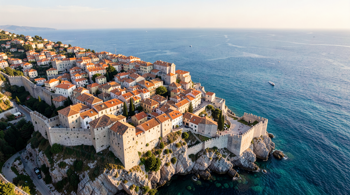
Hvar, regularly described as the sunniest island in the Adriatic, is accessible by ferry from Split and combines lavender fields, the 16th-century Fortica fortress, and the Pakleni Islands anchorage. 8 Korcula Island is frequently cited as one of Croatia's most historically preserved islands, with a walled medieval town and claims to being Marco Polo's birthplace. Dubrovnik closes the itinerary with its iconic limestone city walls, Old Town Stradun, and cable car ascent to Mount Srd. Most specialist guides recommend allocating a minimum of two full days here to adequately experience the walls, Lokrum Island, and the broader old town. 9
Tour Formats and Pricing Benchmarks
Ten-day Croatia tours are available in several formats, each with distinct cost structures. Guided small-group coach tours typically cover transport, accommodation, daily breakfast, and selected entrance fees, with per-person pricing generally falling between approximately USD 3,200 and USD 4,000 for 2026 departures on programs that include four-star hotel accommodation. 10 Cruise-format tours aboard smaller Adriatic vessels, which combine two hotel nights in Zagreb with seven nights on a deluxe ship, are priced from around GBP 2,065 per person for 2026 itineraries. 11 Independent self-planned itineraries, factoring in mid-range accommodation, ferry connections, and ground transport but excluding international flights, typically fall in a range of EUR 1,600 to EUR 2,300 for ten days. 12
Daily budget benchmarks for mid-range independent travel are estimated at EUR 80 to EUR 180 per person per day, covering accommodation, food, local transport, and entry fees. 13 Single room supplements on guided packages represent an additional cost, with some operators citing figures around USD 1,490 for the full tour period. Travelers should note that all standard packages exclude international airfare and most lunches and dinners unless specifically stated in the tour inclusions.
Transportation Between Cities and Islands
Ground transport on the Croatian mainland is primarily handled by modern intercity coach services. FlixBus provides coverage across the country with advance online ticketing, while private transfers between cities like Dubrovnik and Split take approximately four hours by road. 14 The state-operated Jadrolinija ferry network and the faster Krilo catamaran service connect the mainland to the islands, with multiple daily departures during peak season. Typical inter-island ferry journeys range from one to four hours depending on the specific route. 15
Rental cars are widely considered the most flexible option for exploring the mainland and reaching destinations such as Plitvice Lakes or the Peljesac Peninsula independently. However, rental cars cannot be taken onto most island ferries without advance booking, and parking in Dubrovnik's old town area carries significant practical constraints. Travelers combining land and sea segments should plan vehicle logistics carefully, particularly during the July and August high season when ferry capacity fills quickly. 16
Best Travel Season and Crowd Considerations
May, June, and September are consistently identified as the most favorable months for a 10-day Croatia tour. During May and June, the Adriatic Sea temperature is swimmable at approximately 18 to 22 degrees Celsius, Hvar's lavender fields are in bloom, and accommodation rates across most of the spectrum run approximately 30 to 40 percent lower than August levels. 17 September offers arguably the best swimming conditions, with sea temperatures reaching 24 to 26 degrees Celsius, retreating summer crowds, and exceptional autumn light across the limestone Dalmatian coast.
July and August represent peak season with the heaviest tourist concentrations. Dubrovnik's medieval streets, which were not designed for the volume of contemporary visitor traffic, experience particularly intense pressure in these months, with cruise ship arrivals alone bringing tens of thousands of day visitors to the Stradun each day. 18 Plitvice Lakes similarly draws large queues during August; guides recommend arriving at the park entrance before 8 AM to access the lower waterfall-rich section before crowds peak. Winter travel is a viable alternative for those specifically seeking lower visitor volumes, with some operators offering dedicated off-season programs covering Plitvice, Split, Zadar, and Zagreb.
Practical Travel Requirements and Limitations
Croatia joined the Eurozone in January 2023, replacing the Kuna with the Euro (EUR) as its official currency. 19 Citizens of the United States and most Western passport holders can enter Croatia visa-free for tourism stays of up to 90 days within any 180-day period under Schengen Area regulations. 20 English is widely spoken in tourist-facing businesses, hotels, and restaurants across the main itinerary cities.
Travel insurance covering medical expenses, trip interruption, and baggage protection is broadly recommended for any Croatia tour. Policy costs for a 10-day European trip typically range from approximately USD 50 to USD 150 depending on the level of coverage selected and the traveler's country of origin. 21 Physical fitness considerations matter on certain itinerary segments: Plitvice Lakes involves several kilometers of walking on wooden boardwalks and uneven terrain, Dubrovnik's city walls require sustained stair climbing in warm temperatures, and some island excursions involve tender boat transfers with limited accessibility. Tour operators generally classify these programs as medium physical intensity and advise participants accordingly.
Sources
- EuropaAdventure - 10-Day Discover Croatia: From Capital to Coast (europaadventure.com)
- Multiday.tours - 10-Day Croatia Itinerary Guide (multiday.tours)
- A Couple for the Road - The Perfect Croatia Itinerary (acouplefortheroad.com)
- Multiday.tours - Flights and Open-Jaw Routing (multiday.tours)
- Marzito Travel - 10 Days in Croatia and Slovenia (marzito.com)
- Plitvice Lakes National Park Official Site (np-plitvicka-jezera.hr)
- Traveler Legacy - Discover Croatia: Perfect 10-Day Itinerary (travelerlegacy.com)
- Traveler Legacy - Hvar Island Section (travelerlegacy.com)
- Travel Lemming - The Best Croatia Itinerary for 10 Days (travellemming.com)
- Sunny Land Tours - Croatia 10 Days Dalmatian Sunshine (sunnylandtours.com)
- Cruise Croatia and Beyond - Croatia Unveiled 2026 Zagreb to Dubrovnik (cruise-croatia-and-beyond.co.uk)
- Multiday.tours - Typical Trip Cost Section (multiday.tours)
- Wonderplan - Croatia Itinerary 10 Days 2026 (wonderplan.ai)
- Trip.com - 10-Day Adriatic Sea Highlights Tour (trip.com)
- Jadrolinija Ferry Network (jadrolinija.hr)
- Easy Balkan Transfers - Balkans in 10 Days (easybalkantransfers.com)
- A Couple for the Road - Timing and Seasonality Section (acouplefortheroad.com)
- A Couple for the Road - Crowd Considerations (acouplefortheroad.com)
- Wonderplan - Croatia Currency and Practical Info (wonderplan.ai)
- US Embassy Croatia - Visa and Travel Information (hr.usembassy.gov)
- Travel Insurance Master - Travel Insurance Cost (travelinsurancemaster.com)
Authored by 24Trendz team