Osteoporosis Early Detection: A Clinical Guide to Tools, Screening Thresholds, and Emerging AI Methods
Osteoporosis is widely described as a silent disease because bone loss progresses gradually, without pain or visible symptoms, until a fracture occurs. Approximately 10 million Americans already have the condition, while an additional 44 million are at risk due to low bone mass. 1 One in three women and one in five men over age 50 will experience an osteoporotic fracture in their lifetime, making early detection both a public health imperative and a personal health priority. 2
The Gold Standard: DXA Scanning and Diagnostic Thresholds
Dual-energy X-ray absorptiometry, universally known as the DXA or DEXA scan, remains the reference-standard method for measuring bone mineral density (BMD) and diagnosing osteoporosis in clinical practice. 3 The World Health Organization defines osteoporosis as a T-score of minus 2.5 or below at the femoral neck, total hip, or lumbar spine, while a T-score between minus 1.0 and minus 2.5 constitutes osteopenia, a precursor state. Peak bone mass in men and women occurs around age 30, after which bone formation gradually falls behind resorption, accelerating sharply in women following menopause due to estrogen deficiency. 4
A 2025 study published in BMC Musculoskeletal Disorders demonstrated that adding distal radius BMD measurement to the conventional two-region DXA assessment (femoral neck plus lumbar spine) significantly increased osteoporosis detection in fragility fracture patients. Among 1,205 participants, the two-region approach identified osteoporosis in 46.2% of cases, while adding the distal radius elevated that figure to 61.6%. 5 This finding underscores that single-site BMD measurement can underestimate disease burden and that multi-site protocols provide a more complete diagnostic picture.
Screening Guidelines: Who Qualifies and When
The U.S. Preventive Services Task Force (USPSTF) recommends bone density screening for all asymptomatic women aged 65 years and older. For postmenopausal women younger than 65, screening is recommended when fracture risk is equal to or greater than that of a 65-year-old white woman without additional risk factors. 6 The American College of Physicians similarly recommends screening women aged 65 and older, while both bodies currently recommend against routine osteoporosis screening in men in the general population. 7
Certain clinical subgroups require earlier screening outside these age thresholds. Women with premature ovarian insufficiency, defined as loss of ovarian function before age 40, are at elevated risk due to early-onset estrogen deficiency, and baseline DXA screening is recommended at the time of diagnosis in this group. 8 Modifiable risk factors that may trigger earlier or more frequent assessment include low body weight, inadequate calcium and vitamin D intake, sedentary lifestyle, active smoking, and corticosteroid use. The Fracture Risk Assessment Tool, known as FRAX, is widely used alongside BMD results to estimate an individual's 10-year probability of major osteoporotic fracture and guide treatment decisions. 9
AI-Driven Opportunistic Screening: Repurposing Routine Imaging
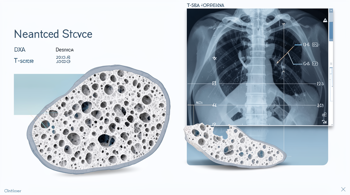
A rapidly growing body of research is demonstrating that AI algorithms can extract bone density signals from imaging studies originally ordered for unrelated purposes. Researchers from St. Paul's Hospital and National Taiwan University published findings in npj Digital Medicine showing that AI applied to routine chest X-rays can detect asymptomatic bone loss across populations systematically excluded from conventional screening, including healthy-weight individuals, younger adults, and men. Critically, more than half of confirmed abnormal bone-density cases in that study occurred in people with a normal body mass index, revealing a diagnostic blind spot in guideline-based criteria. 10
A separate deep learning model called OsPenScreen, trained on 77,812 paired chest X-ray and DXA datasets using knowledge distillation techniques, was validated across four independent datasets totaling 5,935 images from diverse institutions and demonstrated consistent performance in identifying low bone mass as a precursor to osteoporosis. 11 A multicenter cohort study published in Academic Radiology in 2025 further showed that deep learning applied to both chest low-dose CT and lumbar CT achieved high diagnostic performance for automatic osteoporosis screening, performing consistently across CT scanners from different manufacturers and hospital settings. 12
Clinical Deployment: Real-World AI Performance Data
The AI tool known as Rho, approved by Health Canada, has been deployed at Kingston Health Sciences Centre to analyze standard X-rays from patients aged 50 and older taken for any clinical reason. Over 13 months, Rho analyzed 34,162 X-rays and flagged 19,004 (56%) for low BMD. Radiologists incorporated Rho findings into 7,726 reports, and during the first seven months of reporting, initial DXAs increased by a factor of 1.8 and surveillance DXAs by a factor of 1.4. 13 Of 299 Rho-generated DXAs, 193 patients had low bone mass and 65 had osteoporosis. Rho-generated DXAs identified a greater proportion of patients with low BMD compared to pre-planned DXAs, 87% versus 69%, with the yield particularly marked in males aged 65 and older, 83% versus 45%. 13
A 2026 cost-effectiveness study published in Osteoporosis International modeled deep learning-enhanced opportunistic screening using chest radiographs in Singaporean women aged 50 and older. The analysis found that deep learning screening alone reduced fractures and increased quality-adjusted life-years (QALYs) at an acceptable incremental cost-effectiveness ratio, without requiring the addition of the Osteoporosis Self-Assessment Tool for Asians (OSTA). Adding OSTA marginally improved efficiency but deep learning screening alone was already clinically and economically justifiable. 14
Non-Radiographic Risk Calculators and Machine Learning Predictors
Because DXA access remains limited in many community and lower-resource settings, researchers have developed non-imaging prediction tools. A 2026 study published in BioData Mining used data from 18,179 Korean National Health and Nutrition Examination Survey participants to build an interpretable machine learning calculator identifying 15 essential predictors including age, sex, and BMI. The GradientBoost, CatBoost, and XGBoost algorithms were compared and implemented as an accessible online tool for rapid community-level screening without radiographic equipment. 15
A Stockholm Region study using Stochastic Gradient Boosting on 30,741 osteoporosis patients aged 40 and older achieved AUC scores above 0.899 across all age and sex strata, with the number of primary care visits in the year prior to diagnosis identified as the single most predictive variable across all groups. 16 The Primary Osteoporosis Screening Tool, evaluated in a cross-sectional Chinese study of 2,861 patients with a mean age of 65.67 years, outperformed the established OSTA index on area-under-curve metrics and demonstrated superior sensitivity, particularly in individuals aged 65 and older. 17
Known Limitations, Risk Factors, and Intervention Realities
Despite technological advances, significant structural barriers to osteoporosis early detection persist. Most patients are never screened before experiencing a fracture, and conventional screening criteria routinely exclude healthy-weight individuals, younger adults, and men outside of guideline age thresholds. Biochemical markers such as P1NP and CTX can supplement BMD testing by indicating bone turnover rates and monitoring treatment response, but they are not yet standard in community-based screening protocols. 18 Advanced techniques such as high-resolution peripheral quantitative CT and trabecular bone score provide additional bone quality information beyond standard BMD but remain limited to specialized centers.
Intervention efficacy depends heavily on early action. FDA-approved medications including bisphosphonates can reduce fracture risk by 30 to 50 percent when initiated early, while weight-bearing exercise combined with adequate daily calcium intake of 1,000 to 1,200 mg and vitamin D of 600 to 800 IU represents the evidence-supported first-line prevention strategy. 19 Repeat DXA scans are typically recommended every one to two years following initial diagnosis to monitor progression and treatment response. AI tools, while promising, require radiologist workflow integration and carry the risk that flagged findings may not consistently be included in reports, as demonstrated by the Rho deployment where radiologists included AI findings in only 41% of eligible reports. 13
Sources
- National Osteoporosis Foundation - nof.org
- Vision Transformer Osteoporosis Detection Study - nchr.elsevierpure.com
- Mayo Clinic - Bone Density Test - mayoclinic.org
- Merck Manual Professional Edition - Osteoporosis - merckmanuals.com
- BMC Musculoskeletal Disorders - Distal Radius BMD Study - link.springer.com
- U.S. Preventive Services Task Force - Osteoporosis Screening Recommendation - uspreventiveservicestaskforce.org
- American College of Physicians - Osteoporosis Screening Recommendations - acponline.org
- Cleveland Clinic Journal of Medicine - Premature Ovarian Insufficiency and Bone Density - ccjm.org
- University of Sheffield - FRAX Tool - sheffield.ac.uk/FRAX
- Medical Xpress - AI Repurposes Routine Chest X-rays for Bone Loss Detection - medicalxpress.com
- Archives of Osteoporosis - OsPenScreen Deep Learning Model - link.springer.com
- Academic Radiology - Deep Learning Chest LDCT and Lumbar CT Study - doi.org/10.1016/j.acra.2025.09.015
- Skeletal Radiology and KHSC - Rho AI Tool Clinical Impact - link.springer.com / kingstonhsc.ca
- Osteoporosis International - Deep Learning Chest Radiograph Cost-Effectiveness Study - link.springer.com
- BioData Mining - Non-Radiographic ML Osteoporosis Calculator - link.springer.com
- Scientific Reports - Stockholm Region Machine Learning Osteoporosis Prediction - nature.com
- European Journal of Medical Research - POST Screening Tool Study - link.springer.com
- American Association of Clinical Endocrinologists - Bone Turnover Markers - aace.com
- NIH Osteoporosis and Related Bone Diseases National Resource Center - bones.nih.gov
Authored by 24Trendz team