Effective ingredients in dark spot removers for the face
Dark spots on the face - whether from sun exposure, acne, or hormonal shifts - trace back to a single biological root: excess melanin produced by overactive melanocytes. The enzyme tyrosinase controls the rate-limiting steps of melanin synthesis, converting the amino acid L-tyrosine into L-DOPA and then into dopaquinone, the molecular precursor to visible pigment. 1 Every clinically validated brightening ingredient either slows this enzyme, blocks melanin transfer to surrounding skin cells, accelerates the shedding of already-pigmented cells, or intercepts the upstream signals that trigger the cycle in the first place. 2 Understanding which mechanism applies to which ingredient is the foundation for evaluating any dark spot formulation.
Hydroquinone: The Clinical Benchmark
Hydroquinone has served as the gold standard for treating hyperpigmentation for over 60 years and remains the single most studied topical depigmenting agent available. 3 It functions by inhibiting tyrosinase, the copper-dependent enzyme that melanocytes use to synthesize pigment, effectively switching off melanin production at its source. Prescription-strength formulations at 4% produce faster results than over-the-counter 2% versions, and most patients see visible fading within 4 to 8 weeks of consistent nightly use. 3
Regulatory frameworks differ significantly by country. The U.S. Food and Drug Administration has classified hydroquinone as an approved skin-lightening agent at concentrations up to 2% in OTC products, while 4% formulations require a prescription. 4 Long-term or high-concentration unregulated use carries a rare but documented risk of exogenous ochronosis, an irreversible bluish-gray skin discoloration. Clinical guidelines therefore recommend hydroquinone as a short-course treatment paired with mandatory daily SPF 50+, never as an indefinite standalone regimen. 3
Vitamin C and Its Role as a Tyrosinase Inhibitor
Vitamin C, primarily in its L-ascorbic acid form, is both an antioxidant and a direct tyrosinase inhibitor. It neutralizes the reactive oxygen species generated by UV exposure that activate melanocytes, while simultaneously interfering with the enzymatic oxidation steps in melanin synthesis. 5 Stabilized formulations matter considerably: pure L-ascorbic acid is the most studied form but oxidizes rapidly, whereas derivatives such as 3-O-ethyl ascorbic acid offer greater formula stability at a modest potency trade-off. 6
A 10% L-ascorbic acid concentration is recognized as a meaningful therapeutic dose in brightening serums, and vitamin C pairs well with tranexamic acid by addressing complementary points in the pigmentation pathway. 7 Sensitivity and stinging are common at higher concentrations, particularly when combined with exfoliating acids, so patch testing before full application is advisable for reactive skin types.
Niacinamide and Tranexamic Acid: Newer Evidence-Backed Alternatives
Niacinamide (vitamin B3) works at a distinct step in the melanin lifecycle - it inhibits the transfer of melanosomes from melanocytes to surrounding keratinocytes rather than blocking melanin synthesis itself. At 4 to 5%, topical niacinamide has demonstrated hyperpigmentation improvement in approximately 8 weeks, and one peer-reviewed narrative review spanning literature from 2015 to 2025 reported that topical 4% niacinamide showed efficacy comparable to 4% hydroquinone with better tolerability, less erythema, and less dryness. 8 Its anti-inflammatory and barrier-protective properties make it a practical option for sensitive skin and post-inflammatory hyperpigmentation (PIH).
Tranexamic acid (TXA) was originally developed as a hemostatic medication, but Japanese and Korean researchers in the early 2000s observed that patients taking it orally experienced unexpected melasma fading. 9 Topically, TXA interrupts plasmin-driven signaling pathways that instruct melanocytes to overproduce melanin following inflammation or UV damage. A randomized, double-blind clinical trial published in Scientific Reports (2025) compared niosomal TXA 2%/niacinamide 2% cream and conventional TXA 5%/niacinamide 4% cream against hydroquinone 4% cream across 99 melasma patients over three months, with all three treatment groups showing a considerable reduction in melanin index. 10 Most individuals using topical TXA report noticeable improvement within 4 to 8 weeks of consistent application.
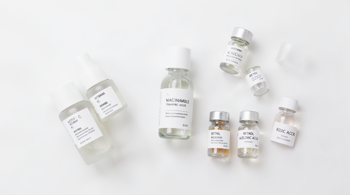
Retinoids and Alpha Hydroxy Acids: Cell Turnover Strategies
Retinoids - including prescription tretinoin and over-the-counter retinol - address hyperpigmentation through a fundamentally different mechanism from tyrosinase inhibitors. They accelerate epidermal cell turnover, meaning pigmented cells are shed faster than new pigment accumulates, gradually normalizing skin tone over consistent use across multiple skin cycles. 11 Prescription-strength tretinoin produces measurable improvement in solar lentigines and PIH, while retinol requires longer timelines due to its lower conversion rate to active retinoic acid in the skin.
Alpha hydroxy acids (AHAs) such as glycolic acid and lactic acid, along with polyhydroxy acids (PHAs) like gluconolactone, work by chemically loosening the bonds between surface corneocytes, accelerating the exfoliation of pigmented skin cells. 12 Mandelic acid is a larger-molecule AHA associated with lower irritation potential, making it suitable for darker skin tones where aggressive exfoliation can paradoxically trigger PIH. AHA-based formulations should always be followed by broad-spectrum sunscreen, as exfoliation increases UV sensitivity.
Kojic Acid, Azelaic Acid, and Arbutin: Supporting Tyrosinase Inhibitors
Kojic acid, derived from Aspergillus and Penicillium fungi, chelates the copper ions in tyrosinase's active site, directly impairing the enzyme's function. It is frequently combined with other actives in professional brightening formulas targeting age spots and melasma. 13 Cosmetic formulations typically use it at concentrations between 1% and 4%, though kojic acid is known to be unstable in light and air, limiting its shelf-life effectiveness in poorly packaged products. A prescription formula combining kojic acid 6%, azelaic acid 6%, hydroquinone 4%, hydrocortisone 1%, and tretinoin 0.05% represents a multi-pathway compounded approach seen in clinical settings.
Azelaic acid is a naturally occurring dicarboxylic acid found in wheat, rye, and barley and produced by Malassezia yeast. Its dual mechanism - selective tyrosinase inhibition in hyperactive melanocytes plus meaningful anti-inflammatory action - makes it particularly effective for PIH and melasma. 14 Cosmetic concentrations range from 5 to 10%, while pharmaceutical-grade formulations at 15 to 20% require professional guidance. Alpha arbutin, a glycosylated hydroquinone derivative, inhibits tyrosinase with lower irritation risk than hydroquinone itself and is considered a well-tolerated option for sensitive skin types. 2
Emerging Actives, Multi-Pathway Approaches, and the Role of Sunscreen
Research published in Dermatology and Therapy (2026) examined 2-mercaptonicotinoyl glycine (2-MNG, trademarked as Melasyl), an ingredient derived from L'Oréal's screening of 100,000 candidates over 18 years. Rather than inhibiting tyrosinase, 2-MNG binds melanin precursors directly, targeting a later, previously untargeted stage of pigment formation. 15 In a two-part clinical study in China - one UV-induced pigmentation model with 32 subjects and one open-label study with 42 subjects treated for 56 days - the 2-MNG serum produced measurable reductions in melanin index and improvements in individual typology angle (ITA°) values. 15 Licorice root extract, containing the active compound glabridin, also merits attention: it inhibits tyrosinase while simultaneously modulating the COX/prostaglandin E₂ inflammatory pathway, making it a dual-action active for PIH specifically.
No topical ingredient performs optimally without daily broad-spectrum SPF protection. UV exposure continuously restimulates melanocytes, reversing progress from any brightening regimen. SPF 30 blocks approximately 97% of UVB, while SPF 50 blocks approximately 98%. 2 UVA penetrates windows and drives dermal pigmentation, which means indoor sun protection is not optional during treatment. For deeper complexions where visible light can independently deepen pigmentation, tinted mineral sunscreens containing iron oxides provide an additional layer of protection beyond standard UV filters. Multi-pathway formulations that combine tyrosinase inhibition, melanosome transfer blockade, and antioxidant support consistently outperform single-ingredient approaches in published evidence for persistent or complex hyperpigmentation. 16
Sources
- northbiomedical.com - Tyrosinase Inhibitors: The Skincare Ingredients That Actually Fade Dark Spots, Ranked by Evidence
- livetinted.com - Do Dark Spot Correctors Work? 2026 Guide
- medsbase.com - Hydroquinone Cream: Uses, Strengths and Best Products (2026)
- Healthline - Best Dark Spot Remover Ingredients (healthline.com)
- Cleveland Clinic - How to Get Rid of Dark Spots on Face (health.clevelandclinic.org)
- dermapproved.com - Kiehl's Clearly Corrective Dark Spot Solution Review
- layered-skincare.app - Tranexamic Acid for Dark Spots: How It Works and How to Use It
- apcz.umk.pl - Topical niacinamide in the management of melasma and facial hyperpigmentation: a narrative review (Quality in Sport)
- layered-skincare.app - Tranexamic Acid for Dark Spots: How It Works and How to Use It
- doi.org/10.1038/s41598-025-26693-8 - Safety and efficacy of niosomal and conventional tranexamic acid/niacinamide vs. hydroquinone creams in melasma (Scientific Reports, 2025)
- doctronic.ai - Dark Spot Removers: Which Ingredients and Products Actually Fade Sun Damage
- Healthline - Glycolic Acid and AHAs for Hyperpigmentation (healthline.com)
- WebMD - Hyperpigmentation Treatment Overview (webmd.com)
- boldpurity.com - Azelaic Acid for Skin: Benefits, Mechanism and How It Targets Pigmentation
- link.springer.com - Evaluation of the Efficacy of a 2-MNG-Containing Serum on Improving Skin Tone and Hyperpigmentation (Dermatology and Therapy, 2026)
- glabridinchina.com - The Best Brightening Actives for Hyperpigmentation Formulas and How to Choose Between Them
Authored by 24Trendz team