12-Day Trip to Japan: A Complete Planning Guide for First-Time Visitors
Planning a 12-day trip to Japan is widely regarded as hitting the sweet spot between the Golden Route's classic arc and the depth needed to experience Japan beyond surface-level tourism. Twelve days allows travelers to move through Tokyo, Kyoto, and Osaka at a measured pace while incorporating day trips to destinations like Nara, Hakone, or Hiroshima without feeling perpetually in transit. The framework below draws on documented itineraries, cost data, and logistical realities to help travelers understand what this duration actually covers and what tradeoffs it requires.
The Classic Golden Route: What 12 Days Typically Covers
A standard 12-day itinerary for first-time visitors typically follows the Golden Route, connecting Tokyo, Kyoto, and Osaka. 1 The most frequently documented allocation places four days in Tokyo, four days in Kyoto, and three days in Osaka, with one or two days reserved for transit and day trips. 2 This structure allows enough time to explore Kyoto's northern temple districts, the geisha quarter of Gion, and the Arashiyama bamboo grove without compressing everything into a single exhausting day.
Beyond the standard Golden Route, an evolved version known as the New Golden Route extends the itinerary through the Japanese Alps, incorporating Takayama, Shirakawa-go, and Kanazawa. This loop adds significant geographic and cultural variety, covering mountain architecture, sake brewing towns, and preserved samurai districts that the standard route bypasses entirely. Day trips from the primary bases add further range: Kamakura from Tokyo, Nara from Kyoto or Osaka, and Himeji Castle as a stop between Kyoto and Osaka. 3
Transportation: JR Pass vs. Individual Tickets
The Japan Rail Pass offers unlimited travel on JR-operated trains, including most Shinkansen routes, for 7, 14, or 21 consecutive days and must be purchased before arriving in Japan. 4 For a 12-day itinerary on the standard Golden Route, whether the pass pays off depends entirely on the specific stops planned. A route that includes multiple Shinkansen legs, such as Tokyo to Kanazawa via the Hokuriku Shinkansen, plus regional trains through mountain areas, may tip the calculation in favor of the pass. Travelers focused only on the Tokyo-Kyoto-Osaka corridor may find individual tickets comparable in total cost.
For city-level transport, IC cards are essential. Suica, Pasmo, or ICOCA cards function across trains, metro systems, buses, and convenience stores throughout Japan, enabling contactless payment without purchasing individual tickets at each station. 5 Luggage forwarding services, known as TA-Q-BIN, allow travelers to send bags between hotels overnight, making Shinkansen journeys considerably more comfortable. Bags can be dropped at the hotel or a convenience store and typically arrive the next day. 6
Accommodation Types and Cost Ranges
Japan offers a wider range of accommodation formats than most destinations, each with distinct tradeoffs. Ryokans, the traditional Japanese inns, provide tatami-mat rooms, yukata robes, multi-course kaiseki meals, and access to communal onsen baths, with rates generally starting at $100 to $300 per night including meals. 7 Business hotels represent the most practical mid-range option at roughly $60 to $120 per night, offering reliable location near train stations and consistent amenities. Capsule hotels average $30 to $60 per night, while hostels run $20 to $40 per night for dormitory-style accommodation. 8
Base area selection within each city matters considerably. In Tokyo, Shinjuku provides the broadest train connectivity and practical access across the city, while Shibuya suits travelers prioritizing nightlife and access to Harajuku and Omotesando. Ginza and the area around Tokyo Station offer easier Shinkansen access. In Kyoto, Kyoto Station remains the most logistically efficient base for day trips, while Gion and Higashiyama provide closer proximity to the temple districts and greater atmospheric character. Accommodation in popular areas during peak seasons should be booked two to three months in advance. 9
Budget Expectations for 12 Days
Budget estimates for a 12-day trip to Japan range from approximately $1,500 to $2,500 per person for travelers keeping costs minimal, rising to $3,000 to $5,000 or more for mid-range comfort, in both cases excluding international airfare. 10 One documented group of four travelers spent approximately $6,000 total, or $1,500 per person, covering lodging, tickets, tours, dinners, and drinks across a 12-day itinerary that included Tokyo, Kyoto, Okinawa, and Osaka. This figure excluded flights and personal shopping expenditures. Daily carry recommendations for cash expenses sit between 10,000 and 20,000 yen to cover cash-only establishments. 11
Cash remains widely used throughout Japan, particularly at temples, shrines, traditional restaurants, and rural areas, despite expanding credit card acceptance in urban centers. ATMs at Seven-Eleven locations and Japan Post branches reliably accept foreign debit and credit cards for yen withdrawals. 12 Pocket Wi-Fi rentals and travel eSIMs provide consistent mobile data access for navigation and translation apps, at an approximate cost of $5 to $10 per day, and can be arranged for pickup directly at Narita, Haneda, or Kansai International airports. 13
Best Seasons and Timing Considerations
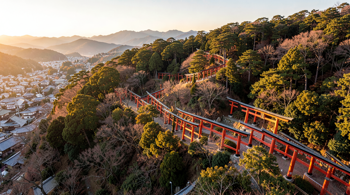
Spring, specifically late March through early April, and autumn in November represent Japan's two peak travel windows, driven respectively by cherry blossom viewing and fall foliage. 14 These periods deliver the country's most visually distinctive experiences but bring substantially higher accommodation demand and heavier crowds at well-known sites. Major destinations like Fushimi Inari in Kyoto, Senso-ji in Tokyo, and the bamboo groves of Arashiyama can see hour-long queues during peak weeks. Early morning visits to these sites, arriving before 8:00 a.m., consistently deliver significantly reduced crowd density.
Mid-summer travel from July through August brings high humidity and heat that adds notable physical strain to a multi-city itinerary involving considerable walking. Golden Week, the national holiday cluster running from late April through early May, compresses domestic travel demand and drives hotel rates sharply upward. Winter travel and early summer, roughly June excluding the rainy period, generally offer lower accommodation rates and thinner crowds at most attractions, though the absence of seasonal foliage changes the visual character of the trip. Ten days is described as the minimum to cover the Golden Route without rushing, while fourteen days is considered the more comfortable sweet spot for a first visit. 15
Entry Requirements, Safety, and Practical Realities
Citizens of many countries, including the United States, can enter Japan visa-free for tourism for up to 90 days with a valid passport, requiring no advance visa application under the temporary visitor status. 16 Japan is consistently regarded as one of the most beginner-friendly destinations for independent travel. Train punctuality is a defining feature of the rail network, with Shinkansen arrivals accurate to the minute, making multi-city itineraries feasible in ways that are difficult to replicate elsewhere. Major stations carry English signage, and station staff at transit hubs are generally equipped to assist international visitors with directions and platform navigation.
Travelers should be aware of several practical realities specific to Japan. Public trash bins are almost entirely absent from street-level environments, requiring travelers to carry waste until reaching a convenience store. Tipping is not practiced and may cause discomfort if attempted. Shoes are removed at ryokans, many traditional restaurants, and most temple interiors, with the raised genkan step at the entrance serving as the standard indicator. Advance reservations are strongly recommended for popular restaurants, high-demand attractions that require timed entry, and Shinkansen seats during busy travel periods, particularly during cherry blossom season. Accommodations booked four months in advance are noted as a reliable lead time for securing preferred options without availability constraints.
Route Variations Beyond the Golden Route
Multiple documented itinerary frameworks extend the 12-day format beyond the standard Tokyo-Kyoto-Osaka corridor. One alternative traces a loop through central Japan using Nagoya as a base, with day trips into Aichi and Gifu prefectures and coastal access along the Izu Peninsula through Shimoda and back through Kamakura. This route visits destinations largely unfamiliar to most international travelers while still using Tokyo as the entry and exit point. A separate approach begins in Fukuoka in southern Japan and travels northward toward Tokyo, often paired with a South Korea leg using the Busan-to-Fukuoka ferry crossing.
A 12-day itinerary focused on hidden destinations uses Kyoto and Osaka as bases for day trips to less-visited locations including Hikone castle town, the coastal city of Shirahama, Kii-Katsuura, and Minoh Park near Osaka, rather than the repeatedly covered Nara-Arashiyama-Fushimi circuit. This approach suits repeat visitors or travelers specifically seeking to avoid the highest-traffic sites. Regardless of route structure, all documented itineraries consistently emphasize the same logistical foundation: IC cards for local transport, reliable mobile data, carrying sufficient yen, and booking popular elements well ahead of arrival. 17
Sources
- Lonely Planet - lonelyplanet.com/japan/itineraries
- mytripblueprint.com - 12 Days in Japan: Day-by-Day Itinerary + Map (2026)
- japanlinked.com - 12 Days in Japan Itinerary: The New Golden Route Done Right
- JR East Official - jreast.co.jp/e/pass/
- JR East - jreast.co.jp/e/pass/suica.html
- mytripblueprint.com - Planning Tips for This Japan Itinerary
- Booking.com - booking.com/searchresults.html?ss=Japan
- Budget Your Trip - budgetyourtrip.com/Japan
- Japan National Tourism Organization - jnto.go.jp
- Budget Your Trip - budgetyourtrip.com/Japan
- japanactivity.com - 2 Week Japan Itinerary: The Ultimate First-Timer's Guide
- Discover Japan Web Magazine - discoverjapan-web.com
- Global Advanced Communications - globalwifi.com/japan-pocket-wifi
- Japan Guide - japan-guide.com/e/e2400.html
- stardrift.ai - First-Time Japan Travel Guide (2026)
- Ministry of Foreign Affairs of Japan - mofa.go.jp/j_info/visit/visa/short/novisa.html
- ateaspoonoftravel.com - Unique 12 Day Japan Itinerary: Local Hidden Gems Beyond Kyoto
Authored by 24Trendz team