Surplus military ATV trailers available for purchase: An Analysis of Government Auctions and Tactical Utility Models
Buyers seeking robust, heavy-duty towing solutions frequently look to surplus military ATV trailers available for purchase as rugged alternatives to standard commercial options. These trailers, originally designed to sustain harsh field environments, are constructed to demanding defense specifications that prioritize structural longevity over aesthetic appeal. Government departments regularly decommission and liquidate these assets once they are deemed excess to operational needs, providing civilian access to highly durable equipment for utility work, agricultural hauling, and off-road expedition projects.
The versatility of these military-grade platforms has driven significant interest among private operators. While standard commercial trailers often struggle under intense stress or on highly uneven terrain, tactical military models feature heavy-duty suspension assemblies, high ground clearance, and robust chassis frames. However, the transition from military field operations to public highway towing requires a thorough understanding of model specifications, procurement frameworks, and required mechanical adaptations.
Legacy Steel Haulers: The M101 and M105 Series
For decades, the M101 three-quarter-ton trailer and the larger M105 one-and-a-half-ton trailer served as primary general-purpose cargo haulers for the United States Armed Forces 3. Featuring steel beds, heavy-duty leaf spring suspensions, and robust pintle hitches, these legacy vehicles are highly valued for their simple, durable construction 3. The straightforward engineering of these trailers minimizes maintenance requirements, allowing civilian owners to execute repairs and structural modifications with basic mechanical tools 3.
| Model Variant | Military Payload Rating | Structural Material | Primary Suspension Type |
|---|---|---|---|
| M101 Series | 3/4-Ton (Approx. 1,500 lbs) | High-Strength Steel | Single-Axle Leaf Spring |
| M105 Series | 1-1/2-Ton (Approx. 3,000 lbs) | High-Strength Steel | Heavy-Duty Leaf Spring |
The M101 has emerged as a favored base for custom off-road camping and utility builds due to its manageable footprint and excellent ground clearance 3. Operators frequently remove the original heavy surge brakes or modify the leaf spring configuration to match the track width of civilian towing vehicles 4. Conversely, the larger M105 model, which features air-over-hydraulic braking systems, is better suited for heavy agricultural or construction duties behind medium-duty trucks 2.
Modern Aluminum Tactical Platforms: The M1101 and M1102
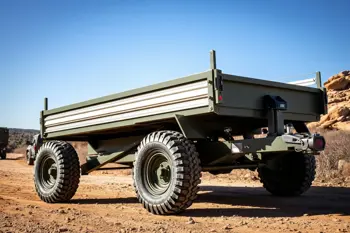
Representing the modern generation of light military trailers, the M1101 cargo trailer and M1102 variant were engineered specifically to be towed by the HMMWV 3. To optimize towing efficiency, these trailers utilize lightweight, aircraft-grade aluminum bodies mounted on high-strength chromoly steel frames 1. These materials protect the structure from environmental corrosion, making them highly resilient for long-term outdoor storage and exposure to coastal environments 6.
The M1102 has a gross vehicle weight rating (GVWR) of approximately 4,200 pounds, with a designated payload capacity of up to 2,740 pounds 1. These trailers feature independent trailing-arm suspensions with progressive-rate shocks, enabling stable towing across extreme terrain while maintaining up to 16 inches of ground clearance under load 1. With 56 inches of clearance between the wheel wells, these platforms easily accommodate standard cargo pallets and compact all-terrain vehicles 1.
Specialized and Modular Containment Logistics
In addition to standard open cargo beds, military logistics frameworks utilize highly specialized, weather-resistant containers designed for integrated transport 8. Systems such as the ISU 96 and ISU 65 cargo units are engineered to secure tactical assets, including smaller all-terrain vehicles and compact support trailers, during long-distance shipping or helicopter airlift maneuvers 8 9. Constructed with robust, mechanically fastened extruded aluminum bases, these enclosed container units provide absolute dust, sand, and moisture protection under extreme field conditions 8.
These heavy-duty modular containment systems often feature integrated ramp assemblies, multi-point internal tie-down tracks, and adjustable shelving networks to keep equipment secure 8. For civilian operators managing complex field logistics, these specialized military enclosures offer unmatched security. However, because these systems are designed to match precise military transport aircraft footprints, their physical dimensions and empty weights require specialized handling equipment 8.
Technical Modernization: Electrical and Brake Conversions
One of the primary engineering challenges faced by civilian buyers of surplus military equipment is the integration of tactical electrical systems with standard civilian tow vehicles. Military trailers are wired natively for 24-volt electrical systems utilizing standard NATO 12-pin connectors, which are incompatible with the 12-volt, 7-pin blade systems found on civilian trucks 6. To achieve operational signaling and brake lights, owners must install voltage reduction converters, swap existing bulbs for 12-volt light-emitting diode (LED) replacements, or rewire the trailer completely 1 6.
Braking systems also demand careful inspection and technical adaptation before public road deployment. Many legacy military trailers utilize heavy hydraulic surge brakes or air-over-hydraulic configurations that may have degraded over long storage periods 2 6. In many instances, civilian builders choose to delete original surge couplers entirely, replacing them with modern electric brake axles or standard ball couplers to ensure reliable, controlled stopping power on steep highway descents 4 5.
Procurement Guidelines, Registration, and Title Acquisition
Acquiring decommissioned assets requires navigating official government liquidation channels or working with certified surplus retailers. The United States General Services Administration (GSA) manages the disposal of surplus federal property through dedicated electronic auction portals, where registered participants can submit bids on available equipment lots 6 8. All personal property sold through these federal channels complies with standard government sales terms, meaning items are typically offered on an as-is, where-is basis with no warranties implied 6.
Securing civilian registration and road titles represents the final phase of the procurement process. Because surplus trailers are liquidated directly from federal service, they generally lack standard civilian titles. Prospective owners must utilize the original military bill of sale, standard manufacturer specification plates, or certified local tag services to apply for a bonded or reconstructed vehicle title in their respective home states 2. Compliance with local state inspection laws is mandatory, requiring verified functionality of all safety systems.
Sources
- Expedition Portal Forums
- The Estate Gallery Online Auctions
- Military Vehicles Vault
- Overland Vehicle Systems Product Data
- Poindaxster Technical Reviews
- U.S. General Services Administration
- Avitec Cargo Pallets and Containers
- GSA Auctions Portal
- Defense Logistics Agency (DLA) Disposition Services
Authored by 24Trendz team