How to tell if a sweater is cashmere, merino, or a blend: A Journalistic Guide to Textile Authentication
When evaluating premium knitwear, consumers often face a confusing marketplace where labels may not always convey the entire truth of a garment's composition. Industry reports reveal that up to 25% of textile items analyzed in specific trade studies show significant discrepancies between their actual fiber content and their printed labels 9. Learning how to tell if a sweater is cashmere, merino, or a blend is not just a matter of sensory appreciation, but an exercise in systematic material authentication. By understanding the microscopic properties, physical behaviors, and labeling standards of these noble fibers, buyers can accurately assess their wardrobe acquisitions and verify the integrity of their investments 5.
The Microscopic Difference: Fiber Diameter and Micron Metrics
The primary physical differentiator between these premium fibers lies in their diameter, measured in microns (one-thousandth of a millimeter). True cashmere is harvested from the soft undercoat of the Capra hircus goat, primarily raised in cold mountain regions such as Mongolia and China 2. To legally carry the name "cashmere" under regulations like the U.S. Wool Products Labeling Act, the fiber must not exceed an average diameter of 19 microns 4. Grade A cashmere features exceptionally fine fibers measuring between 14 and 15.5 microns in diameter, offering unmatched loft and a cloud-like touch 10.
Merino wool, sourced from Merino sheep primarily raised in Australia and New Zealand, also features fine fibers but generally displays a broader range of 15 to 24 microns 7. This structural difference alters how each fiber interacts with human skin. Fibers under 19 microns rarely trigger skin sensitivity, which explains why cashmere feels immediately silky and non-irritating 2. While fine merino wool is highly comfortable, its slightly larger average diameter and distinct scale structure give it a more structured, resilient feel compared to the delicate fluffiness of cashmere 1.
In-Store Evaluation: Tactile and Visual Assessments
Before checking the label, several physical tests can be performed directly on the retail floor to evaluate a garment's quality. The first is the thermal response test. Natural cashmere has an airy fiber structure that traps heat efficiently, warming up almost instantly when held in the hand 2. Merino wool also warms quickly but carries a slightly cooler, denser feel upon initial contact 16. In contrast, synthetic acrylic or polyester blends remain cool to the touch for longer and feel unnaturally slippery or plastic-like 18.
Another reliable indicator is the stretch and recovery test. Gently pull the sweater horizontally and release it. True cashmere and high-quality merino wool possess excellent natural elasticity due to the crimp of their natural fibers; they will bounce back to their original shape smoothly 16. Synthetics or heavily diluted blends may feel stiff, lose their shape permanently, or remain overly springy 16. Furthermore, check the surface of the knit. Authentic cashmere displays a soft, distinct "halo" of loose, fluffy fibers that develops naturally with wear, whereas synthetic blends often show a flat, dull, or overly shiny surface on day one 16.
Performance and Everyday Wear Characteristics
The choice between these fibers often comes down to the intended environment and physical activity level of the wearer. Merino wool is highly regarded for its physical resilience and moisture-wicking capability 1. It is naturally odor-resistant, highly breathable, and can withstand frequent wear, making it the preferred choice for activewear, travel, and daily layering 13. Cashmere is significantly warmer by weight, insulating up to eight times better than standard sheep's wool 7, but it is a much more delicate fiber that is prone to abrasion 13.
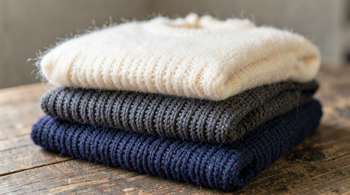
Understanding how these garments wear over time also helps identify their composition. While all natural fibers can experience some degree of friction wear, cashmere is notably prone to pilling due to its fine, short-staple undercoat fibers 20. Merino wool, which features longer staple lengths and higher fiber tensile strength, resists pilling much better and is significantly easier to wash and maintain 14. Cashmere requires gentle hand-washing in cold water and flat drying to prevent shrinking and fiber damage 21.
The Lab Test: The Burn Test and Technical Authentication
When legal or commercial authentication is required, industry experts rely on laboratory analysis, such as light microscopy, scanning electron microscopy (SEM), and even biomolecular DNA testing to distinguish fibers 3. For individual consumers looking to verify loose yarn or a sacrificial thread from an old garment at home, the classic burn test offers immediate chemical insights.
| Fiber Type | Reaction to Flame | Odor Produced | Residue Left |
|---|---|---|---|
| Pure Cashmere / Merino | Burns slowly, self-extinguishes | Distinct burnt hair smell | Soft, easily crushable dark ash |
| Synthetic (Acrylic/Polyester) | Melts and burns rapidly | Chemical, sweet, or acrid odor | Hard, uncrushable plastic bead |
| Cellulose (Viscose/Cotton) | Burns rapidly with a yellow flame | Burnt paper smell | Light grey, fluffy ash |
Understanding Fiber Blends and Deceptive Labeling
To balance production costs and enhance fabric durability, many manufacturers produce blended sweaters. A common and practical middle ground is a blend of 70% merino wool and 30% cashmere, which delivers much of the signature softness of cashmere alongside the structural durability of merino 20. Some blends incorporate synthetic fibers like nylon, polyester, or acrylic to improve shape retention, increase machine-washability, and lower market prices.
However, consumers must remain vigilant against deceptive marketing terms. Labels using phrases like "cashmere-soft," "cashmere-feel," or "pashmina" are often entirely synthetic garments made of acrylic or polyester designed to mimic natural textures 10. By law in the United States and many international jurisdictions, manufacturers must disclose the exact percentage of each fiber by weight on the permanent care label 5. Always locate this physical tag inside the garment seam rather than relying on loose hangtags or descriptive packaging.
Market Valuation and Sourcing Reality
The final element of verification is the price-to-rarity ratio. Cashmere is an inherently scarce resource. A single cashmere goat produces only 50 to 80 grams of clean, usable fiber annually, meaning it takes the harvest of multiple goats to produce a single sweater 2. Consequently, genuine, high-quality cashmere sweaters typically retail between $150 and $500 23. Merino sheep yield several kilograms of wool per shearing, making merino a more abundant and affordable option, with high-quality sweaters generally priced between $50 and $150 2.
When encountering knitwear priced far below these market averages that claims to be pure cashmere, it is highly probable that the item is a low-grade blend, contains recycled fibers of shorter staple length, or is fraudulently labeled. Assessing the source of the wool, examining the garment structure, and utilizing physical touch tests remain the most reliable defenses for any knitwear enthusiast.
Sources
- SELVANE - Cashmere vs. Merino Wool: Luxury Fiber Comparison (https://www.selvane.co/blogs/knowledge/cashmere-vs-merino-wool-a-fiber-by-fiber-comparison-for-different-wardrobe-needs)
- Vercate - What's the Difference Between Merino Wool and Cashmere? (https://vercate.com/en/blogs/sustainability/what-is-the-difference-between-merino-wool-and-cashmere)
- GLYarn - The Complete Procurement Guide: How to Identify and Authenticate Cashmere Yarn (https://www.glyarn.com/the-complete-procurement-guide-how-to-identify-and-authenticate-cashmere-yarn/)
- SELVANE - How to Identify Real Cashmere: A Buyer's Guide (https://www.selvane.co/blogs/knowledge/how-to-identify-real-cashmere-a-buyers-guide-to-avoiding-blends)
- Misciano - How to Authenticate Real Cashmere (https://misciano.com/en/pages/cashmere-authentication-guide)
- Sashu The Label - Merino Wool vs Cashmere: Which Natural Fiber Is Right for You? (https://sashuthelabel.com/blogs/weekly-fashion-tips/merino-wool-vs-cashmere-which-natural-fiber-is-right-for-you)
- Rita Cashmere - Cashmere Sweater Buying Guide: How to Choose High-Quality Cashmere (https://ritacashmere.com/cashmere-sweater-buying-guide/)
- SELVANE - How to Evaluate Cashmere Quality In-Store (https://www.selvane.co/blogs/knowledge/how-to-evaluate-cashmere-quality-in-a-store-a-tactile-guide-for-informed-buyers)
- Loop Cashmere - What's The Difference Between Cashmere, Merino, Mohair, and Wool? (https://www.loopcashmere.co.uk/blogs/loop-life/whats-the-difference-between-cashmere-merino-mohair-and-wool)
- WFS Cashmere - Cashmere vs Merino Wool: Weighing the Pros and Cons (https://www.wfscashmere.com/cashmere-vs-merino-wool-weighing-the-pros-and-cons.html)
- CH Cashmere - How to Tell Real Cashmere From Blends (https://www.chcashmere.biz/post/how-to-tell-real-cashmere-from-blends)
- Sweater Factory - How to Tell Real Cashmere from Fake Cashmere (https://www.bngarment.com/how-to-tell-real-cashmere/)
- Lin Sweater - Cashmere Grades Explained: A, B, C and What Buyers Need to Know (https://en.linsweater.com/blog/cashmere-grades-explained.html)
- Onward - How To Identify, Care For, And Restore Quality Cashmere (https://onwardcashmere.com/identify-care-restore-quality-cashmere/)
- Fineast Cashmere - Top 7 Authentication Methods for Online Shoppers (https://fineastcashmere.com/blogs/blog/breaking-news-cashmere-industry-experts-reveal-top-7-authentication-methods-for-online-shoppers)
Authored by 24Trendz team