A guide to purchasing major kitchen appliances using flexible payment options: Consumer finance analysis
Appliance costs and financing fundamentals
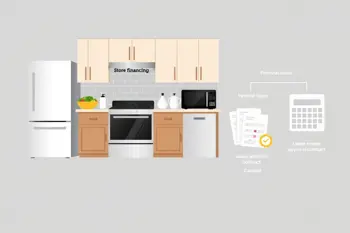
Major kitchen appliances commonly include refrigerators, ranges, dishwashers, and microwaves. Research citing HomeAdvisor places the average price of a new home appliance at $2,175, while a complete kitchen suite can cost approximately $4,000 to $12,000. 1 These figures explain why a household replacing several items may consider installment financing instead of paying the entire amount at checkout. The relevant comparison is not just the monthly payment, but the total amount paid after interest, fees, delivery, installation, and any required insurance or service charges.
Appliance financing can take several forms: a retailer credit account, a general-purpose credit card, a fixed-rate personal loan, BNPL installments, layaway, or a lease-to-own contract. 2 Each structure changes when ownership begins, how long repayment lasts, whether interest is charged, and what happens after a missed payment. A financially workable arrangement should fit the appliance cost and the household's repayment period without relying on uncertain future income.
Store cards and deferred-interest arrangements
Retailer credit programs may provide 0% APR for a stated period, commonly 12 to 18 months in the appliance-financing data, while some store programs advertise terms extending from 6 to 24 months for qualifying purchases. 1 Best Buy, Home Depot, and Lowe's are identified in the research as retailers with proprietary credit programs or appliance financing terms. 3 Eligibility, minimum purchase thresholds, required credit inquiries, and available terms vary by retailer and applicant.
A major distinction is between a genuine introductory APR and deferred interest. Under deferred interest, interest may accrue during the stated interest-free period and become payable retroactively if the entire balance is not cleared by the deadline. 4 A remaining balance that appears small can therefore trigger a substantially higher cost. Before using a store account, the shopper should identify the standard APR, deadline, minimum monthly payment, late-fee policy, and whether the account reports activity to credit bureaus.
Personal loans for larger appliance purchases
A personal loan can combine several appliance purchases into one fixed-rate installment plan, with funds generally usable at different retailers. PrimeRates describes fixed rates commonly ranging from 6% to 15% for some borrowers and notes that prequalification can allow comparisons without an initial credit-score impact. 1 MoneyLion reports a broader personal-loan APR range of 6% to 36%, depending on the borrower and loan terms. 3 These figures are category ranges, not guaranteed offers.
The principal advantages are a defined repayment schedule and a predictable monthly obligation. A loan can be considered when the purchase exceeds $1,500, when several appliances are needed, or when repayment will extend beyond a retailer's introductory period. 3 The evaluation should include origination charges, late fees, loan duration, total interest, funding timing, and the effect of a hard inquiry if the borrower proceeds beyond prequalification. A longer term lowers the scheduled payment but can increase the total financing cost.
BNPL and installment checkout plans
BNPL services divide a purchase into scheduled installments, often four payments over six weeks or monthly payments over three to twelve months. 7 Some providers use a soft credit check or no traditional credit check for smaller transactions, while longer or larger plans may assess credit and charge interest. 5 Retailers may integrate providers such as Affirm or Klarna into checkout, but approval, spending limits, repayment dates, and interest terms are determined by the provider and applicant profile.
Short repayment windows can make BNPL unsuitable for a full kitchen suite even when the advertised installment appears manageable. The Federal Trade Commission states that plans can impose payment, late, or date-change fees, and automatic withdrawals may create overdraft charges when the linked account lacks sufficient funds. 5 Missed payments may also affect credit depending on the provider's reporting practices. 3 Multiple simultaneous plans can make total monthly obligations harder to track.
Lease-to-own and rent-to-own contracts
Lease-to-own arrangements generally allow a person to take possession of an appliance while making weekly or monthly payments, with ownership transferring after the final payment or an early purchase. 6 These programs may not require a conventional credit score, which can expand eligibility for applicants with limited or damaged credit. 8 However, accessibility does not indicate affordability. The contract may require a longer payment period, and returning the appliance may leave the consumer without ownership of payments already made.
SuperMoney reports that total payments for rent-to-own appliances typically reach two to five times the item's retail price, with agreements commonly lasting 12 to 24 months. 6 The effective markup can be especially high compared with conventional financing. Important questions include the cash price, total scheduled payments, early-buyout calculation, delivery charges, maintenance responsibility, late-payment consequences, and whether the item can be repossessed. A low weekly figure should never substitute for reviewing the full contract total.
Comparing eligibility, risk, and total cost
The following comparison summarizes how the principal options differ. Actual APRs, qualification standards, fees, and contract terms vary by provider, retailer, state, purchase amount, and applicant. 2 The table is therefore a framework for reading offers rather than a directory of current terms.
| Option | Typical use | Primary issue to examine |
|---|---|---|
| Store credit | Qualifying retailer purchases | Deferred interest and deadline |
| Personal loan | Purchases above $1,500 or multiple appliances | APR, fees, and repayment length |
| BNPL | Shorter installment schedules | Payment timing, fees, and credit reporting |
| Lease-to-own | Limited or damaged credit | Total payments and ownership terms |
A disciplined comparison begins with the cash price and adds every financing charge. For a store account, the required payoff amount should be divided across the promotional months, with a margin for unexpected expenses. For a personal loan, the disclosed total repayment is more informative than the monthly figure. For BNPL, the payment calendar should be checked against income dates. For lease-to-own, the cash price should be compared directly with the full scheduled cost and any early-buyout amount.
Practical protections before signing
Credit applications may create hard inquiries, while some prequalification processes use soft inquiries that do not affect the credit score. 4 Consumers should distinguish those processes before submitting multiple applications. The contract should identify the creditor or leasing company, APR or equivalent charge, total repayment, minimum payment, due dates, late fees, cancellation rules, ownership status, and dispute procedures. Retailer financing is not automatically less expensive simply because it is offered at the point of sale.
Regulatory and consumer-protection information also matters. The Federal Trade Commission advises reviewing BNPL, rent-to-own, lease-to-own, and layaway details because fees and payment structures can produce a higher-than-expected total. 5 The Consumer Financial Protection Bureau has reported that BNPL borrowers may be more financially vulnerable and may accumulate overlapping obligations. 3 Appliance buyers should preserve receipts and contracts, verify delivery and installation responsibilities, and avoid choosing an arrangement solely because approval requirements appear less restrictive.
Sources
- PrimeRates, Appliance Financing Options: Best Ways to Pay
- Credible, Appliance Financing: What To Know
- MoneyLion, How To Finance Appliances: 6 Ways to Manage the Cost
- Experian, Should You Use a Store Card to Buy Appliances for Your New Home?
- Federal Trade Commission, Buy Now, Pay Later, Rent-to-Own, Lease-to-Own, and Layaway
- SuperMoney, Rent to Own Appliances: Washer, Dryer, Fridge & More
- Firstcard, Buy Now Pay Later for Appliances: No Credit Check
- Gerald, How to Finance Appliances: Best Options for Every Budget and Credit Score
Authored by 24Trendz team