Inside the Next Generation: Latest models of autonomous robotic lawn mowers and Smart Landscaping Technologies
The landscape of automated residential maintenance has undergone a rapid transformation with the arrival of the latest models of autonomous robotic lawn mowers. Homeowners and landscaping professionals are increasingly adopting these advanced machines, which replace traditional buried perimeter wires and complex roof-mounted antenna setups with sophisticated multi-sensor arrays and real-time kinematic satellite navigation. By integrating visual artificial intelligence, laser scanning, and network-based positioning, these systems deliver centimeter-level mowing accuracy across diverse and highly complex environments.
Evolution of Sensor Fusion and Wire-Free Navigation
The primary technological bottleneck for earlier generations of robotic mowers was the necessity of physical boundary wires. Modern platforms have bypassed this limitation by adopting multi-sensor fusion systems that integrate multiple inputs simultaneously. For example, STIGA launched its Vista technology series, utilizing an AI camera with HDR global shutter and a quad-band RTK-GNSS engine 1. This dual architecture analyzes satellite signal quality in real-time, allowing the robotic system to adjust its path when moving under dense foliage or near structures.
Similarly, the newly launched ANTHBOT M9 Pro relies on a proprietary HoloSense Quad-Fusion navigation system 2. This setup combines 360-degree LiDAR, standard RTK, network-based NetRTK, and dual AI vision to establish a reliable auto-pilot state across complex gardens. In North America, the debut of the Worx Landroid Vision Cloud highlights a similar trend, utilizing V-SLAM navigation and a neural network trained on millions of real-world mowing hours to identify lawn edges without local hardware configurations 3. These developments signify a shift toward complete spatial awareness.
Over-the-Air Corrections and Antenna-Free Infrastructure
A major friction point for historical high-precision mowers was the installation of stationary RTK reference antennas on rooftops or property fence lines. To mitigate this issue, current designs utilize network-delivered corrections over cellular connections. The Mammotion LUBA series employs NetRTK positioning, linking directly to decentralized reference networks over the air to establish positioning without on-property base stations 4. This setup enables rapid deployment from a smartphone application.
This approach is also central to the Kress EyePilot series, which utilizes cellular-integrated 4G connectivity to transmit RTKn satellite corrections continuously 5. The redundant architecture allows the mower to maintain its coordinate map even when satellite signals are compromised. For smaller residential yards, the Natural Expressions Performance 7 bypasses both RTK networks and LiDAR completely, relying instead on a triple-camera vision system and local AI image processing to define borders and navigate around obstacles in real time 6.
Precision Edging and AI-Driven Mulching Technology
Traditional automated mowers required manual follow-up trimming because their physical chassis prevented close cutting. To address this limitation, the ECOVACS GOAT PRO LiDAR series introduces the TruEdge AI trimmer, which incorporates a fully automated edge cutting tool utilizing high-speed rotating flexible strings 7. The AI camera distinguishes grass from solid structures, extending or retracting the trimmer dynamically along fences, flower beds, and pathways to achieve a finish within two centimeters of the edge.
Other manufacturers have integrated physical design changes to optimize border performance. The Kress EyePilot range utilizes a dedicated ZeroTrim cutting system, which positions the blade disc specifically to cut close to lawn edges, significantly reducing secondary yard work 5. Furthermore, these advanced platforms integrate sophisticated daily mulching protocols, such as the FlowCut technology used in the AIRSEEKERS TRON system, which redistributes finely cut grass clippings back into the turf to support organic soil fertilization 8.
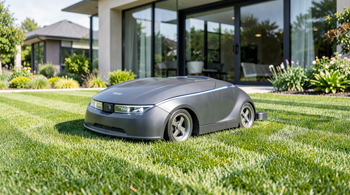
All-Terrain Mobility and Slope Performance
Residential topography varies significantly, requiring autonomous mowers to navigate steep inclines, uneven turf, and wet soil conditions without losing traction. The Dreame A3 AWD addresses these demanding landscapes through an all-terrain four-wheel-drive system capable of climbing slopes up to 80 percent, equivalent to approximately 38.7 degrees, while scaling physical obstacles up to 2.2 inches in height 9. Such high-performance drivetrains prevent the machine from slipping or causing turf damage on sharp gradients.
Similarly, the Kress EyePilot 4x4 models utilize a four-motor drivetrain featuring real-time torque control to maintain traction on slopes up to 84 percent, roughly 40 degrees 5. These units feature articulated geometry to keep all wheels grounded, paired with front-wheel steering to turn without tearing grass. For massive properties, the Yarbo Lawn Mower Pro utilizes dual 300W motors and a heavy-duty chassis to conquer 70 percent slopes while managing up to six acres of turf 10.
Real-Time Obstacle Avoidance and Safety Protocols
Safety remains a critical consideration for autonomous machinery, especially regarding pets and debris. The Roborock RockMow Z120 LiDAR introduces the Sentisphere system, which utilizes 360-degree LiDAR alongside dual high-definition cameras to track and classify objects up to 70 meters away 11. This system captures spatial data at a rate of 200,000 points per second, allowing the onboard processor to execute immediate routing changes when encountering unexpected obstacles.
In smaller-scale residential applications, the Sunseeker S4 integrates automotive-grade 3D LiDAR with its AllSense Vision AI system, powered by a high-performance 10 TOPS processing chip 12. This dual-engine setup operates reliably in both direct midday sunlight and absolute darkness, anticipating movement to prevent collisions with domestic animals. For safety in complex layouts, the ANTHBOT M9 Pro is programmed to recognize over 1,000 distinct obstacle categories, enabling it to navigate safely through spaces as narrow as 65 centimeters 2.
Comprehensive Market Overview and Technical Metrics
While these platforms offer high convenience, consumers face potential friction points such as regional cellular signal dependency for RTKn models, software update stability, and substantial upfront capital costs. The choice of an autonomous mower depends largely on property size, terrain complexity, and budget constraints. The following table provides a technical comparison of prominent autonomous robotic mowers currently entering the market, illustrating their distinct navigation methods, climbing capabilities, and maximum coverage areas.
| Model Name | Navigation Technology | Max Slope Capacity | Coverage Limit |
|---|---|---|---|
| ANTHBOT M9 Pro | LiDAR, RTK, Dual Vision | 45% (24°) | 1,000 m² |
| Dreame A3 AWD | OmniSense 3.0 Vision | 80% (38.7°) | 0.25 Acre |
| Kress EyePilot 4x4 | RTKn & V-SLAM Vision | 84% (40°) | 2.5 Acres |
| Yarbo Pro | RTK & Multi-Sensor | 70% (35°) | 6.0 Acres |
| Sunseeker S4 | 3D LiDAR & Vision AI | 42% (22°) | 0.25 Acre |
Sources
- STIGA Group Corporate Website
- PR Newswire United Kingdom
- CES VPORoom Press Release
- CNET Technology News
- Kress Official Website
- Basic Tutorials Review Platform
- ECOVACS Press Center
- AIRSEEKERS Official European Store
- Dreame Technology US
- Yarbo Official Online Portal
- Irish Mirror Lifestyle Section
- Sunseeker Tech Official Store
Authored by 24Trendz team