Simple strategies for buying exercise equipment on a budget: A Consumer Cost Analysis
Simple strategies for buying exercise equipment on a budget are most effective when purchasing decisions begin with goals, space, and a fixed spending limit rather than a broad equipment wish list. Research on home gyms shows that a functional setup can begin at approximately $100 to $300, while more structured starter systems commonly fall between $200 and $500. 15
Start With Training Goals and Available Space
The intended training outcome should determine the equipment category. A person focused on strength generally needs different tools from someone prioritizing mobility, endurance, or weight management. Resistance bands, adjustable dumbbells, and jump ropes can support multiple movement patterns while requiring little storage. Technogym identifies dumbbells, bands, adjustable benches, stability equipment, medicine balls, and cardio tools as distinct categories whose usefulness depends on the user’s objectives. 8
Space measurement is a financial safeguard because equipment that does not fit becomes an expensive storage problem. The space assessment should include floor dimensions, ceiling height, door clearance, and room around the equipment for movement. One home-gym analysis identifies 4 by 4 feet as a minimum floor area for limited training, while a fuller setup may require roughly 100 square feet and an 8-foot ceiling. 1 A written measurement plan also helps identify whether a bedroom, garage, or living-room corner is appropriate.
Set a Firm Budget and Build in Stages
A staged purchasing plan reduces the risk of buying specialized equipment before basic training needs are covered. Research places a functional entry-level home gym at roughly $100 to $300, a starter tier at $200 to $500, and a complete setup at $3,000 or more. These figures are broad category estimates rather than guarantees, since condition, location, shipping, and brand affect the final amount. 15
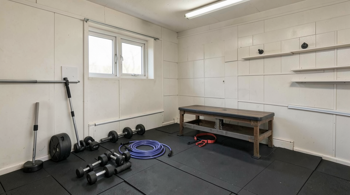
Spending priorities should also include infrastructure. Flooring, lighting, ventilation, storage, and safe clearance can affect whether equipment is usable and durable. One garage-gym analysis recommends addressing flooring and lighting before anchor equipment, while another identifies horse-stall mats at approximately $80 to $120 for two mats in a basic setup. 13 A budget that assigns a separate amount to setup costs is less likely to be consumed entirely by weights or machines.
Prioritize Versatile Equipment
Multi-use equipment generally produces more exercise options per dollar than single-purpose machines. Adjustable dumbbells can replace several fixed-weight pairs, while resistance bands provide variable tension and occupy minimal storage space. Pull-up bars, suspension trainers, and jump ropes can add pulling, bodyweight, and cardiovascular movements without requiring a rack or cable station. 58 These tools are particularly relevant where floor area or household storage is limited.
For barbell-focused training, the purchasing sequence should reflect safety and exercise coverage. The research recommends prioritizing a barbell, rack, plates, and bench before accessories, with dumbbells added later if funds remain. 2 A rack and bench can expand exercise selection, but they also require accurate measurements, stable flooring, and sufficient clearance. Low-cost all-in-one machines may appear efficient, yet one source warns that some inexpensive multi-gyms have limited weight capacities and less useful resistance patterns. 2
Evaluate Used, Refurbished, and Open-Box Equipment
Local secondhand markets can materially change the cost structure of a home gym. Research supplied for this topic indicates that used equipment through peer-to-peer marketplaces may be priced up to 70% below retail, while used iron plates retain their basic function despite cosmetic rust. 2 Local pickup can also reduce delivery costs, although transportation, disassembly, and lifting requirements should be included in the total calculation.
Condition checks must distinguish cosmetic wear from structural damage. A scratched finish on a rack may not affect capacity, but bent uprights, cracked welds, damaged safety pins, frayed cables, unstable benches, or missing hardware create materially different risks. Open-box and discontinued items may be functional, but warranty coverage varies, and some final-sale terms limit remedies. 9 Refurbished equipment sold through established outlets may include a warranty, but documentation should be checked before payment rather than assumed.
Use Timing and Price-Tracking Evidence
Purchase timing can influence the amount paid, especially for large cardio equipment. A market-timing review reports that fitness equipment is listed at promotional pricing for about 19% of the year, with Black Friday and Cyber Monday commonly associated with reductions of 30% to 50% on large cardio machines. 6 The same research identifies January as a period with strong inventory and February through March as a period when lightly used equipment may appear at 40% to 60% below retail after New Year resolution demand fades. 6
Seasonal claims should be treated as patterns, not guarantees. The cited review describes October as a comparatively weak month for pricing and late spring or summer as a period when indoor cardio inventory may receive more favorable pricing. 6 Browser-based price-history tools such as CamelCamelCamel can help distinguish a genuine change from a temporary reference-price adjustment. Retail clearance events and seasonal inventory changes may also affect availability, but stock, shipping charges, and warranty terms remain essential comparison points.
Account for Safety, Maintenance, and Total Cost
The purchase price is only one part of equipment ownership. Flooring protects both the equipment and the underlying surface, while garage environments may require attention to temperature, ventilation, and lighting. A UK home-gym guide notes that garages are commonly suitable for a rack, bench, and floor work but may be cold in winter, hot in summer, and poorly insulated. 4 Residential rooms also require caution around floor loading and impact, particularly when weights may be dropped.
Safety equipment should not be improvised when failure could cause injury. Research specifically supports do-it-yourself lifting platforms or plyometric boxes where appropriate, but advises against making rack pins or comparable protective components independently. 2 Ongoing maintenance includes checking bolts, welds, cables, upholstery, rust, adjustment mechanisms, and flooring. A practical evaluation therefore compares expected use, repairability, warranty, transport, storage, and safety alongside the initial amount paid.
Sources
- Home Gym Foundry, “How to Build a Home Gym: The Complete 5-Step Guide for Any Space and Budget”
- GXMMAT, “Build a Cheap Home Gym That Actually Lasts”
- The Tool Scout, “Garage Gym Setup on a Budget: From $500 to $5,000”
- Gym Gear UK, “How to Set Up a Home Gym on a Budget”
- Marcy, “Best Home Gym Equipment on a Budget”
- DontPayFull, “Best Time to Buy Gym Equipment”
- Garage Gym Reviews, “The Best Budget Home Gym Equipment of 2026”
- Technogym, “How to Choose the Right Home Gym Equipment”
- GXMMAT, “Gym Clearance Equipment: What to Know Before You Buy”
Authored by 24Trendz team